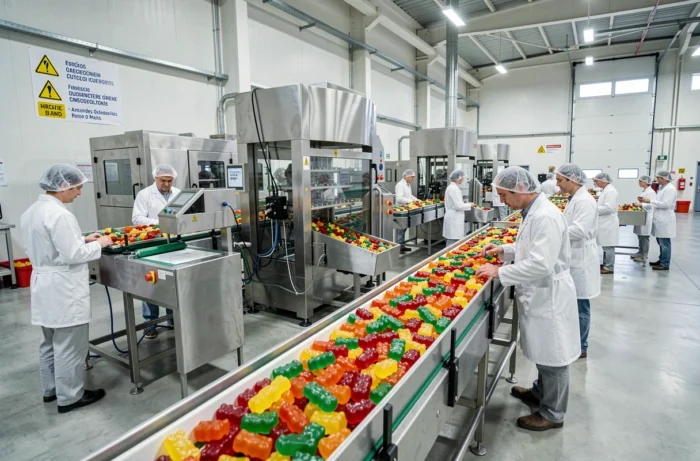
Haribo has been making candy in France for several decades at its Uzès site in the Gard department. This historic location between Nîmes and Avignon is more than just a place to look back on the past, with its museum: it is an active production plant that supplies a large share of the French market with gummy candy and licorice.
Uzès and Marseille: Haribo’s two production sites in France
Contrary to a common misconception, Haribo candy production in France does not rely on a single site. Two factories share production: Uzès and Marseille.
The Uzès site in the Gard is the oldest. It produces many gummy candy varieties and is also home to the French subsidiary’s head office. The Marseille factory adds to this capacity with its own production lines.
To better understand the role of each location, a detailed article traces the history and operations of the Haribo factory in France and explains how production is divided between the two sites.
New Haribo factory in Uzès: an industrial project in progress
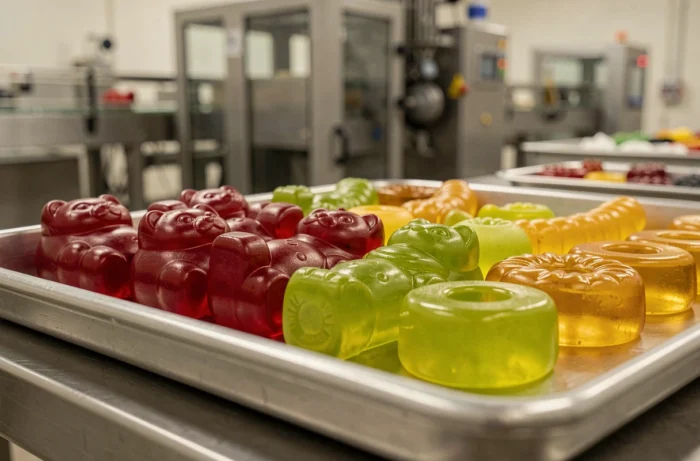
Haribo is doing more than maintaining its existing facilities. The group is preparing to build a new factory near its historic Uzès site, with operations expected to begin at the end of 2029.
This project is more than a simple expansion. It is an industrial transformation that reorganizes production in France. Some of the manufacturing currently carried out in Marseille is set to move to this new site in the Gard.
The project is expected to create around 30 jobs in Uzès. For the local employment area, already shaped by Haribo’s presence, this transfer will strengthen the Gard site’s role in the group’s industrial strategy.
What this transfer means for Marseille
Production at the Marseille site will decline as some lines move to Uzès. The exact division of production between the two factories after 2029 has not yet been made public, but the trend is clear: Uzès is becoming Haribo’s main manufacturing hub in France.
How Haribo gummy candy is made: the starch-molding process
Most Haribo candies (Goldbears, Dragibus, Tagada) are gummy candies. They are made using a specific process that uses starch as a temporary mold.
Here’s how it works: trays filled with corn starch pass under a press that stamps hundreds of small cavities into the starch. Each cavity corresponds to the shape of a candy (a bear, strawberry, or ring). A hot syrup made from sugar, glucose, gelatin, and flavorings is then poured into these impressions.
- The syrup is poured at a high temperature so the mixture stays fluid and fills every detail of the starch mold.
- The trays then go into drying rooms for several hours, allowing the gelatin to set and the candy to develop its characteristic chewy texture.
- After demolding, the candies are separated from the remaining starch by sifting, then passed through a polishing drum that gives them their glossy appearance.
- The recovered starch is dried and reused for new molding cycles, helping to reduce material waste.

Extrusion: a second process for different textures
Not all Haribo candies are made using starch molds. Licorice products and some denser-textured candies are made by extrusion. The mixture is pushed through a die that gives it its shape (lace, roll, or stick), then cut to the desired length.
This distinction between starch molding and extrusion explains why the Haribo range offers such a variety of textures, from soft Goldbears to compact Rotella licorice and melt-in-your-mouth Tagada strawberries.
Haribo Candy Museum in Uzès: a visit and a closer look
The Haribo Candy Museum in Uzès traces the history of the brand and of confectionery in general. It also explores the historic connection between Haribo and Zan licorice, a brand acquired by the group whose production has been integrated into the Gard site.
The visit takes in several themed areas: the history of licorice and its cultivation, the evolution of confectionery techniques, and an overview of the Haribo range through the decades. A shop sells products, including some varieties that are hard to find in supermarkets.
For families, the museum makes a natural stop during a stay in the region between Nîmes and Avignon. Uzès itself is also worth a visit for its historic center and market.

Haribo candy and gelatin: a frequently asked question
The gelatin used to make Haribo gummy candy comes mainly from animal sources (pork or beef, depending on the product). This is a frequent concern among consumers, particularly those who follow diets that exclude certain animal-derived ingredients.
Haribo offers a few products labeled vegetarian, which replace animal gelatin with plant-based gelling agents. Rotella licorice, for example, is sold as a vegetarian candy. Check each product individually on the packaging, as ingredients vary from one product to another within the same range.
With its new factory planned for 2029 and its museum open to the public, the Uzès site remains the heart of Haribo’s presence in France. The ongoing reorganization between Uzès and Marseille shows that the group is investing in modernizing its French industrial operations rather than moving production abroad—a decision that will shape candy production in the Gard for years to come.