In France, the term “chambre d’hôtes” is subject to a specific regulatory framework: accommodation in the host’s home, breakfast included, and a limit of five rooms and fifteen guests. Hotels, by contrast, are officially rated in stars by an accredited body. These two statuses involve different obligations and services, making any direct comparison between star ratings and private labels misleading.
Star ratings and private labels: two systems that don’t align
France’s hotel rating system is based on a national set of measurable criteria, including room size, bathroom facilities, reception services and accessibility. A chambre d’hôtes cannot receive this rating. The distinctions it may display (Gîtes de France ears of corn, Clévacances keys or other labels) follow standards specific to each network, with different criteria and assessment methods.
There is therefore no technical basis for comparing “three stars” with “three ears of corn.” To assess a chambre d’hôtes, it’s better to review the criteria for the label it displays and check recent reviews, rather than assume it is equivalent to a hotel rating.
One more widely applicable benchmark is the Green Key label, which covers both hotels and chambres d’hôtes under a shared framework addressing water, energy, waste and purchasing. The label does not indicate comfort levels, but it does make it possible to compare the environmental commitments of different types of accommodation.
Understanding the differences between a hotel and a chambre d’hôtes starts with letting go of the idea that there is a single rating scale that applies to both.
Legal requirements for chambres d’hôtes: what the term guarantees guests
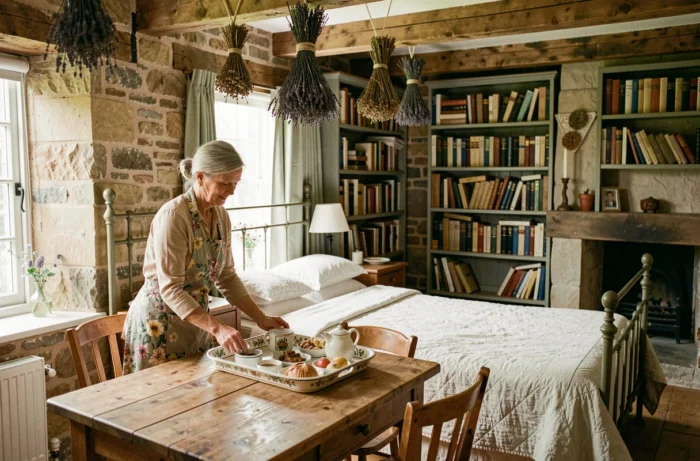
The term “chambre d’hôtes” is more than a marketing label. It commits the operator to several requirements set out in law.
- The host must be on site: guests stay in the operator’s home or in an outbuilding on their property, meaning they have direct contact with the person welcoming them.
- Breakfast must be included in the room rate and prepared and served by the host.
- Capacity is limited to five rooms and fifteen guests, ruling out larger establishments that use the term without meeting its requirements.
- The operator must register the business with the local town hall. If dinner is offered as a table d’hôtes, additional rules apply, particularly regarding food hygiene.
If accommodation advertised as a “chambre d’hôtes” offers more than five rooms or does not include breakfast, it does not meet the legal requirements for using the term. Checking these details before booking can help avoid disappointment when some platforms use the term incorrectly.
Hotel services and the chambre d’hôtes experience: two different ways to stay
A rated hotel offers reception services with extended opening hours, and sometimes a 24-hour front desk. Guests can arrive late, leave early, request concierge services or use shared facilities (such as a restaurant, bar, pool or gym), depending on the hotel category. Its operations are structured and consistent from one stay to the next, especially at chain hotels, which guarantee a uniform level of service.
A chambre d’hôtes works in the opposite way. Arrival times are arranged with the host, dinner is not always available, and facilities vary considerably from one property to another. In return, the welcome is based on direct interaction with the owner, who knows the area and can offer highly tailored recommendations.
This distinction has practical implications when choosing where to stay. A business trip with strict scheduling can be a poor fit for a chambre d’hôtes where the host is only reachable by phone after a certain time. A couple or family on a sightseeing trip is more likely to benefit from personalized recommendations and a table d’hôtes, if one is available.
Breakfast: a clear point of difference
At a chambre d’hôtes, breakfast is included in the room rate and is often made with local or homemade products. At a hotel, it usually costs extra unless a specific package is booked. This can make a significant difference to the budget over a stay of several nights.
Prices and rate transparency: compare like with like
Comparing the base nightly rate for a hotel and a chambre d’hôtes without factoring in breakfast, tourist tax and any extras (such as parking or Wi-Fi access at some hotels) can be misleading. At a chambre d’hôtes, the advertised rate includes breakfast. At a hotel, the base rate generally covers the room only.
Rates at chambres d’hôtes vary widely depending on the location, level of comfort and season. Some high-end properties cost more than a three-star hotel in the same area. The assumption that “chambres d’hôtes are cheaper” does not always hold, especially in popular tourist destinations.
For a reliable comparison, make sure you’re comparing the same things: a night’s stay with breakfast, taxes included, and equivalent services (bed linen, daily housekeeping or no daily housekeeping). Hotels provide daily housekeeping in almost all cases. Practices vary at chambres d’hôtes.
Choosing accommodation to suit your trip
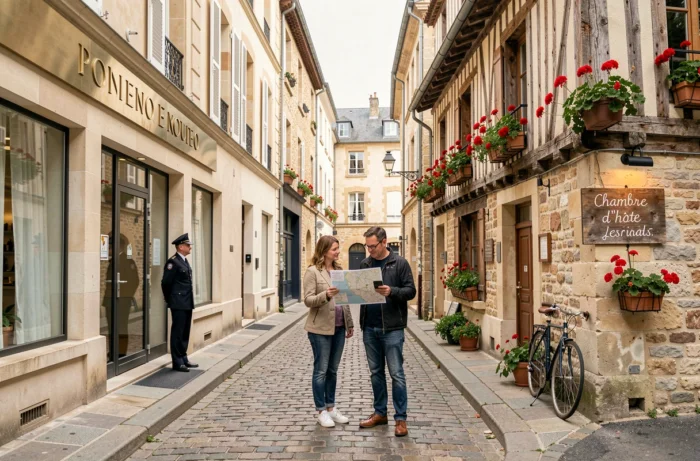
Choosing between a hotel and a chambre d’hôtes is about more than comfort or price. It depends on the kind of trip you have in mind.
A business traveler passing through, arriving late and leaving early, needs an accessible reception desk and standardized services. A hotel is better suited to these needs. A couple hoping to explore a region over several days will get more out of staying with a host who knows the local producers and less-traveled trails.
The deciding factor is how much independence you want. A hotel offers complete independence from the host. A chambre d’hôtes involves some social interaction, which is an integral part of the experience. Some travelers see this as a plus; for others, it’s a drawback.
Because the two types of accommodation do not share a common rating system, online comparisons are only approximate. Checking the accommodation’s actual status, what is included and the terms of the welcome remains the most reliable way to make an informed choice.