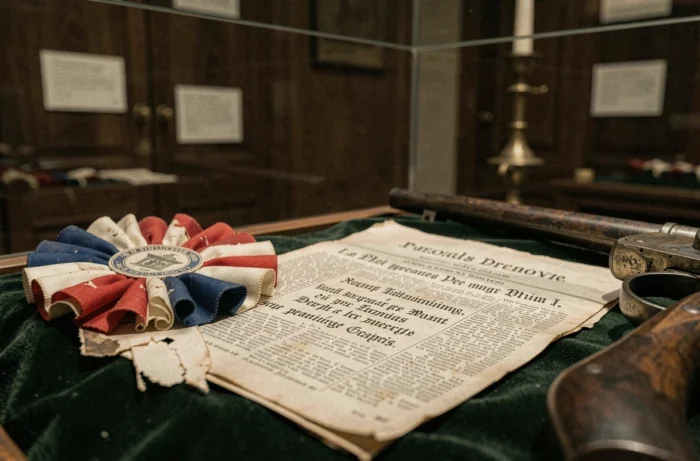
The July Revolution, known as the Three Glorious Days, refers to three days of insurrection in Paris, from 27 to 29 July 1830, which led to the abdication of Charles X and the end of the Bourbon Restoration.
The immediate trigger was a few lines published in Le Moniteur on 26 July: five royal ordinances suspending freedom of the press, dissolving the newly elected Chamber of Deputies and restricting the right to vote. What unfolded went beyond popular anger: it was a constitutional crisis over the limits of royal power as set out in the Charter of 1814.
Article 14 of the Charter of 1814: the legal crux of the ordinances
Charles X did not sign his ordinances on a whim. He relied on Article 14 of the Charter of 1814, which authorized the king to take regulatory measures “for the execution of the laws and the security of the State.”
The conflict centered on how this wording should be interpreted: the ordinances of 25 July did not merely regulate the application of existing laws; they affected areas that fell under the chambers’ authority to legislate, particularly freedom of the press and the electoral system.
To learn more about the 1830 revolution and Charles X, it is important to understand the gap between what the Charter allowed and what the ordinances imposed. The table below summarizes the main provisions that were challenged.
| Ordinance | Subject | Relevant provision of the Charter |
|---|---|---|
| Suspension of freedom of the press | Ban on publishing without prior authorization | Article 8 (freedom of opinion and publication) |
| Dissolution of the Chamber of Deputies | Annulment of recent elections | Articles 15–16 (shared legislative power) |
| Change to the electoral system | Restriction of the electorate to landowners only | Articles on property-based voting qualifications |
| Summoning of new electoral colleges | Elections under the newly restricted system | A matter normally within the legislature’s remit |
The Charter, revised after the Three Glorious Days, removed the reference to “the security of the State” from the king’s prerogatives and explicitly prohibited the king from suspending laws. This constitutional safeguard was a direct consequence of Charles X’s expansive use of Article 14.

Timeline of the Three Glorious Days: three days of fighting in Paris
The mobilization did not begin at the barricades. It began in the printing houses. On 27 July, journalists and printers published protests despite the ban. Printing workers took to the streets alongside students and artisans. Within hours, the dispute over the press had turned into an armed insurrection.
On 28 July, barricades sprang up across the eastern districts of Paris. The royal troops, commanded by Marshal Marmont, struggled to control a city whose maze of narrow streets they did not know. Fighting claimed lives on both sides, and several regiments began fraternizing with the insurgents.
On 29 July, the insurgents took control of the Hôtel de Ville and the Tuileries Palace. Charles X, holed up at Saint-Cloud, no longer had any military leverage in the capital. He abdicated a few days later and set off into exile in England.
- 27 July: journalists protest, the first clashes break out, police shut down printing houses, and typographers resist
- 28 July: barricades go up in working-class districts, clashes with Marmont’s troops, and defections from the royal army begin
- 29 July: the Hôtel de Ville and the Tuileries are seized, royal authority collapses in Paris, and Charles X flees to Saint-Cloud
Who won the Three Glorious Days: the insurgent people or the parliamentary liberals?
Workers, students and artisans fought at the barricades. They paid the human cost of the insurrection. The political settlement, however, was negotiated by liberal deputies, notably Thiers and La Fayette, who steered events toward a constitutional monarchy rather than a republic.
Louis-Philippe of Orléans ascended the throne with a changed title: he became “King of the French” rather than King of France. The distinction was political. Legitimacy no longer came from divine right, but from a pact with the nation—or at least with the portion of the nation that had the right to vote. The revised Charter expanded certain freedoms, restored the tricolour flag and lowered the property qualification for voting.
Yet the gap between the combatants’ expectations and the institutional outcome remained stark. Universal suffrage was not introduced. The electorate grew, but remained limited to a minority of taxpayers. The republican and social demands voiced in the streets of Paris found no expression in the new regime. The July Monarchy satisfied the liberal bourgeoisie, not the working classes who had overthrown Charles X.

European consequences of the 1830 revolution
The fall of Charles X did not remain a purely French event. It ushered in a wave of revolts across Europe between 1830 and 1831, though their paths diverged according to local balances of power.
The Belgian uprising, which began in August 1830, led to independence from the Netherlands and the creation of a new constitutional state. The Polish uprising against Russian rule, launched in November 1830, was crushed by Tsar Nicholas I. Two revolts inspired by the same event, with opposite outcomes.
This divergence highlights what was distinctive about France: in Paris, the insurrection succeeded because the army broke apart and the liberal bourgeoisie had a viable political alternative ready to put in place. In Poland, neither the military split nor the civilian political leadership existed to the same degree.
The July Monarchy, born of those three days, lasted until 1848. It too was eventually overthrown by a revolution—the February Revolution—which this time established a republic. The Three Glorious Days did not bring France’s revolutionary cycle to a close. They reignited it, showing that a regime could fall in three days while also revealing that victory at the barricades does not guarantee political victory for those who built them.