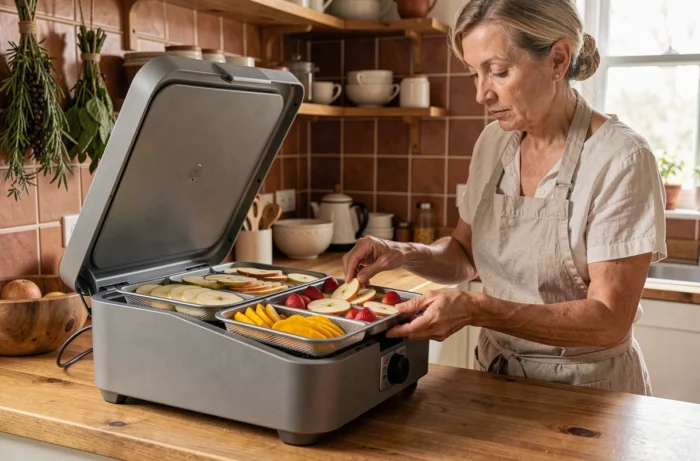
A dehydrator and a desiccator both remove water from fruit to extend its shelf life. Their shared physical principle—controlled evaporation of moisture—masks differences in how they work, which can make one or the other a better choice depending on the volume to process and the desired results.
Food dehydrators and desiccators: two different approaches to removing water
A food dehydrator works by circulating warm air at a low temperature. A fan pushes air heated by a heating element through stacked or horizontally arranged trays. The fruit gradually loses its moisture over several hours at temperatures that rarely exceed 60°C.
A desiccator, on the other hand, uses a desiccant (silica gel, calcium chloride, or another hygroscopic substance) to absorb ambient moisture inside a sealed chamber. It is primarily used in laboratories and industry to preserve samples, protect electronic components, and store pharmaceutical powders.
The two terms are often confused because they appear to produce the same result: a dry product. When comparing a dehydrator and desiccator for fruit, the difference comes down to how moisture is transferred. A dehydrator evaporates water out of the food through thermal convection. A desiccator absorbs water already present in the air around the food, without applying direct heat.
For preserving fruit at home, a dehydrator is the appliance designed for the job. A desiccator offers neither the speed, temperature control, nor capacity needed to process a harvest.
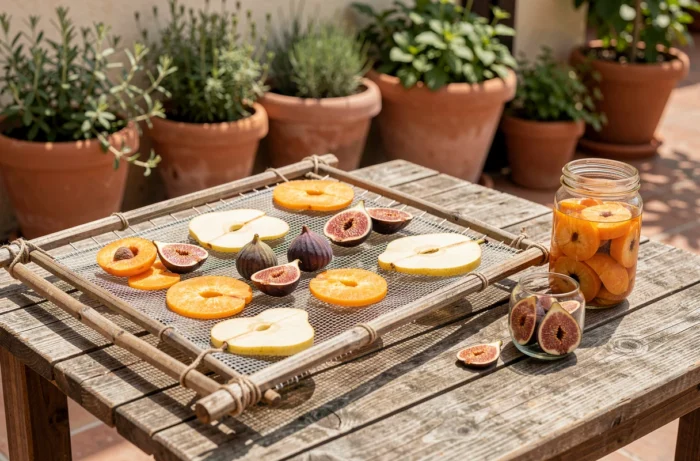
Airflow and temperature: the factors that affect the results when drying fruit
Drying quality depends less on the appliance’s raw power than on how evenly air flows across each tray. A dehydrator with horizontal airflow (with the fan at the back) distributes air more evenly than a vertical-flow model (with the fan at the bottom or top), where trays closer to the source dry faster than the others.
Drying temperature directly affects the fruit’s texture and color. If the temperature is too high, the surface can harden while the center remains moist, encouraging mold growth during storage. Slow, even drying preserves flavor better than rapid drying at a high temperature.
What ventilation changes in practice
With a vertical-flow dehydrator, you need to rotate the trays during the cycle to compensate for uneven airflow. Horizontal-flow models eliminate this step, but they generally cost more.
Fan noise is a factor that is rarely mentioned. Drying fleshy fruits such as mangoes or figs can take more than ten hours. A noisy appliance in an open-plan kitchen can quickly become a nuisance.
How to choose a fruit dehydrator: look beyond wattage
Wattage alone is not enough to distinguish between two appliances. A powerful dehydrator with poor ventilation will produce worse results than a less powerful model with well-distributed airflow. The key factors to consider are:
- Total drying area: this determines how much fruit you can process in one cycle. For regular use with garden harvests, the combined area of several stackable trays can make the difference between a backup appliance and a proper food-preservation tool.
- Tray materials that come into contact with food: racks and trays must be suitable for food contact and designed to withstand the conditions of use. European regulations govern the migration of substances from materials into food, and Regulation (EU) 2024/3190 bans bisphenol A in several categories of food-contact materials.
- Adjustable thermostat: an appliance without temperature control limits what you can dry. Herbs need a lower temperature than apple slices, which in turn require less heat than strips of dried meat.
- Number of trays and expandability: some stackable models let you add extra trays, while others have a fixed capacity determined by the cabinet design.
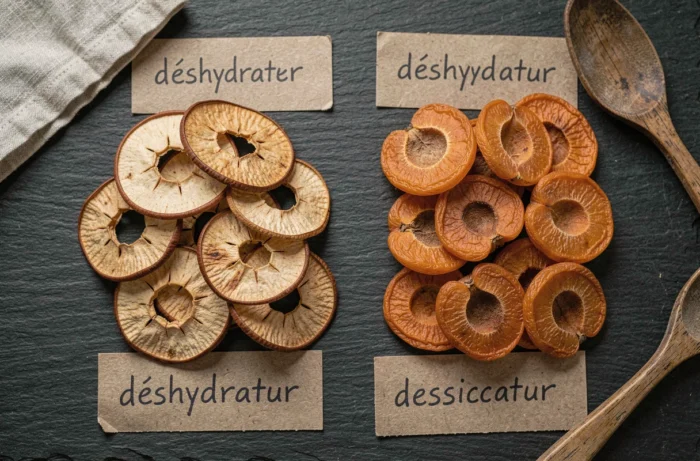
Dehydrator or oven for drying fruit: not really an equivalent choice
A household oven can dry fruit, but it is no substitute for a dehydrator if you plan to do it regularly. Ovens are not designed to maintain a stable low temperature for hours. Most household ovens cannot go below 50 to 80 degrees, depending on the model, and their ventilation is not designed to remove moisture efficiently.
The energy cost of running an oven for an extended cycle is far higher than that of a dehydrator, whose heating element and fan use much less energy. Over a full season of preserving food, the difference adds up.
When an oven is still an option
For an occasional test or a small batch of fruit (a few apple chips for a snack), an oven will do. Leave the door slightly ajar, set it to the lowest temperature possible, and check the fruit regularly. But as soon as the volume or frequency increases, investing in a dehydrator makes sense thanks to its consistent results and ease of use.
Preparing fruit before drying: just as important as the appliance
A good dehydrator cannot make up for poor preparation. Consistent slicing is essential for even drying: slices of uneven thickness will leave you with some pieces that are too dry and others that are still moist at the end of the same cycle.
Fruit that oxidizes quickly (apples, pears, bananas) benefits from a quick soak in lemon water before being placed on the trays. This helps preserve its color without affecting the flavor of the finished product.
The bend test tells you when drying is complete: properly dehydrated fruit bends without breaking and without leaving any trace of moisture. If it feels sticky or releases moisture, extend the cycle. If it snaps cleanly, it has been dried for too long.
For preserving fruit at home, choosing between a dehydrator and a desiccator is not really a question. A warm-air dehydrator is the only appliance suited to this household use. A desiccator belongs to a different technical field: controlling humidity in an enclosed space, with no direct connection to cooking. The real choice is between types of dehydrator and how carefully you prepare the fruit before each cycle.