
The brush cutter market now covers a wide range, from nylon-line trimmers to backpack machines capable of cutting through thick brambles. Choosing a model depends as much on the terrain as on local regulations: in some fire-prone areas, clearing vegetation is a legal requirement for property owners, not just a routine maintenance task.
Municipal or prefectural orders also set the permitted hours for using powered garden tools, which may make a quieter motor a better choice. Before comparing specifications, you need to establish the actual scope of the work.
Legal brush-clearing requirements and the actual area to maintain
Most buying guides approach brush cutter selection in terms of comfort or vegetation type. They overlook a factor that can change everything: clearing vegetation may be required by law in areas at risk of forest fires. This requirement applies to the area around the home and may extend beyond the property boundaries.
This information must be included in the risk report provided when a property is sold or rented. If your land is affected, the area to clear may be larger than your garden alone. A lightweight tool designed for a few lawn edges may not be up to the job.
Before buying, check the status of your property with your local town hall. A full range of brush cutters suited to different needs is available at debroussailleuse-warrior.com, making it easy to compare models once you have clarified the scope of the work.

Petrol, electric or battery-powered brush cutters: what the terrain demands
The power source is about more than just budget. It depends directly on three practical factors: the area, the density of the vegetation and local noise restrictions.
Petrol engines for large plots
Petrol engines remain the go-to choice for large or overgrown plots, where brambles, shrubs and tall grass require sustained power over long sessions. Runtime is unlimited as long as the tank is full. The trade-off: they are significantly louder and heavier than other types of motor.
If your municipality restricts the hours when powered tools may be used (these restrictions are set by local orders, not by a uniform national regulation), check that the permitted time slots are long enough to cover your work area with a petrol-powered machine.
Battery power: an increasingly capable compromise
Battery-powered brush cutters are getting more powerful every year. They are suitable for medium-sized gardens where the vegetation is limited to tall grass and some moderate undergrowth. Their lower noise levels make them suitable for time slots when a petrol model would be prohibited or poorly tolerated by the neighbours.
The main limitation remains runtime. In dense vegetation, a standard battery runs down faster than expected. A second battery can partly address this, but increases the purchase cost.
Corded electric: for use close to home
Corded electric brush cutters are limited to areas close to the house, where a power outlet is within reach. They are suitable for finishing lawn edges and clearing small, flat areas. Beyond that, the extension cord becomes an obstacle on sloping or uneven ground.
Cutting system: nylon line, blade or brush cutter saw blade, depending on the vegetation
The cutting system determines what the machine can actually cut. This point is often glossed over, even though it affects performance just as much as the motor.
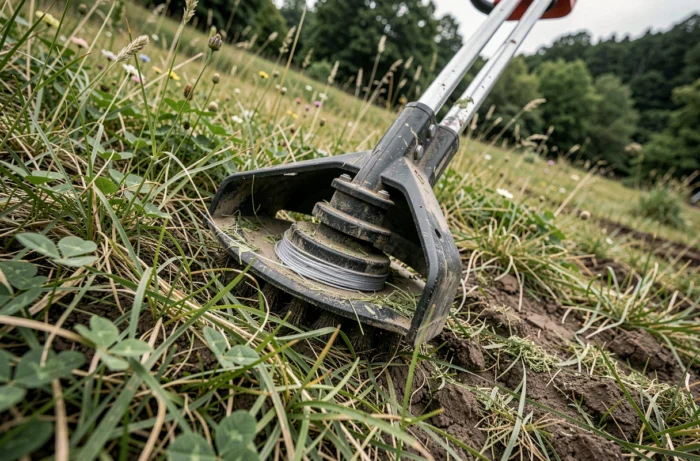
- Nylon line (round or square) is sufficient for soft grass, lawn edging and borders. It wears quickly on woody stems and cannot cut through thick brambles.
- A grass blade (with three or four teeth) cuts tall, dense grass, nettles and ferns. It is not suitable for shrub trunks.
- A brush cutter saw blade (circular saw type) cuts brambles, young shrubs and woody shoots. It requires a powerful machine and a suitable harness to handle the rotational torque.
The same machine can often accommodate several interchangeable cutting systems. Check compatibility before buying: a universal nylon-line head will not fit every brush cutter, and a brush cutter saw blade requires a specific safety guard.
Ergonomics and harnesses: choosing a brush cutter suited to your build
A powerful but poorly balanced machine can tire the user within minutes. Ergonomics comes down to three factors that product specifications do not always highlight.
The handle type affects manoeuvrability. A bike handlebar (U-shaped handle) stabilises sweeping movements on flat, open ground. A loop or D-shaped handle offers greater freedom in confined areas (between trees, along a wall or on a slope).
A harness makes all the difference during long sessions. A simple shoulder strap is enough for a lightweight grass trimmer. For a petrol brush cutter fitted with a brush cutter saw blade, a backpack harness distributes the weight across both shoulders and the hips, reducing fatigue and lower back pain.
The machine’s weight can vary threefold depending on the motor type and engine displacement. On sloping ground, or when legal requirements mean clearing a large area around the home, a machine that is too heavy turns maintenance into a physical chore and encourages you to leave longer between sessions, allowing the vegetation to grow back.
Brush cutter maintenance: points not to overlook
A brush cutter’s lifespan depends on simple but regular maintenance. On a petrol engine, check the air filter and spark plug before each season. A clogged filter reduces power and increases fuel consumption.
Replace the nylon line as soon as it wears below the appropriate cutting length. Continuing to use line that is too short puts strain on the motor and reduces cutting quality. Blades and discs should be sharpened or replaced depending on visible wear on the teeth.
For battery-powered models, storing the battery at room temperature (away from freezing temperatures and excessive heat) helps preserve its capacity over several seasons. A battery left discharged for several months will permanently lose some of its runtime.
Ultimately, choosing a brush cutter starts with an assessment: the actual area to clear (including any legal requirements), the predominant vegetation type and local noise restrictions. These three factors point to a specific motor type and cutting system. Everything else—brand, price and accessories—comes later, not before.