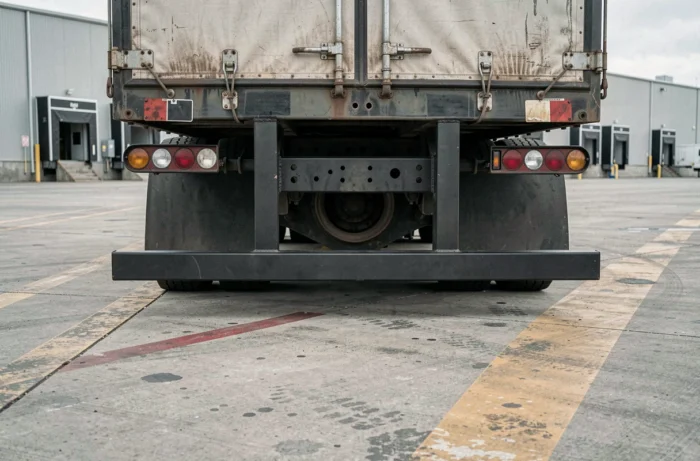
The anti-intrusion bars equip almost all heavy goods vehicles, trailers, and semi-trailers operating in Europe. Their role is to prevent a light vehicle from becoming wedged under the rear or side of a truck during a collision. The regulations governing these devices are based on specific UN regulations, including R58-03 for rear protection, and are integrated into a European framework reinforced by Regulation (EU) 2019/2144 on the general safety of new vehicles.
Regulation R58-03 and European Regulation 2019/2144: Compared Requirements
Two texts structure the compliance of rear anti-intrusion bars. The UN Regulation R58-03 sets the technical specifications of the device itself. Regulation (EU) 2019/2144 imposes, at the European level, that new vehicles comply with these technical requirements to obtain their approval.
| Criterion | UN Regulation R58-03 | Regulation (EU) 2019/2144 |
|---|---|---|
| Scope | Technical specifications of the bar (dimensions, strength, fixation) | General safety framework for new vehicles, refers to R58 for technical requirements |
| Vehicles concerned | Trailers, semi-trailers, trucks | All new vehicles placed on the European market (categories M, N, O) |
| Maximum ground clearance (dimension G) | Variable depending on the type of suspension, measured when empty | Not directly specified (refers to R58) |
| Protection dimension P | Maximum horizontal distance between the bar tube and the end of the bodywork, up to a height of 2 m | Not directly specified |
| Low position requirement | When on public roads, the bar must be in a low position | Integrated via reference to R58 |
Therefore, European Regulation 2019/2144 does not replace R58-03: it makes it mandatory for market placement. A bodybuilder or equipment manufacturer must verify compliance with R58-03 at the device level, while the vehicle manufacturer must ensure compliance with the overall European framework.
The standards to be met for trucks also cover mounting conditions, the quality of fixings, and the rigidity module of the beams on which the bar is installed.
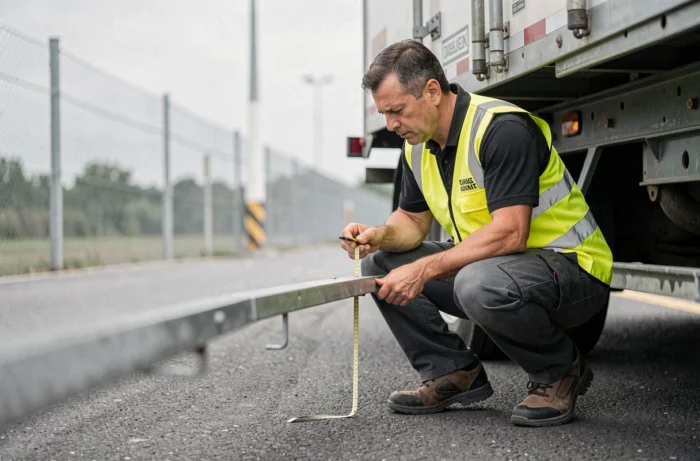
Technical Sizing of a Rear Anti-Intrusion Bar R58-03
The choice of a bar is not just a simple catalog purchase. Several dimensions must be checked to ensure compliance with the installation.
Dimensions to Check Before Installation
- Dimension G (maximum ground clearance): it depends on the type of suspension of the vehicle and is measured when empty. A bar mounted too high loses all effectiveness in the event of a collision.
- Protection dimension P: this is the horizontal distance between the bar tube and the rear end of the bodywork, measured up to a height of 2 m. This value varies depending on the vehicle category and the chosen bar model.
- Dimensions A and B of the chassis: these are used to enter the manufacturer’s selection table. The intersection of these two values allows for the validation of the compatible model.
- Rigidity module of the beams (I/VxRe): expressed in N.m, it varies according to references. The bodybuilder must verify that the vehicle’s beams can withstand the stresses transmitted by the bar in the event of a shock.
Each R58-03 approved bar is delivered with an installation manual that specifies the installation conditions, dimensions, and quality of the required screws. An installation that does not comply with this manual invalidates the approval of the device.
Fixed Bars and Liftable Bars: Two Distinct Configurations
Fixed bars are suitable for standard trucks and trailers. Manual liftable bars are designed for tipping bodies, where the bar must be able to be raised during unloading operations. In both cases, the bar must always be in a low position while in circulation.
On automatic tipping bodies, systems integrate an automatic return to the low position. This type of solution reduces the risk of forgetting, which remains one of the main causes of non-compliance observed during inspections.
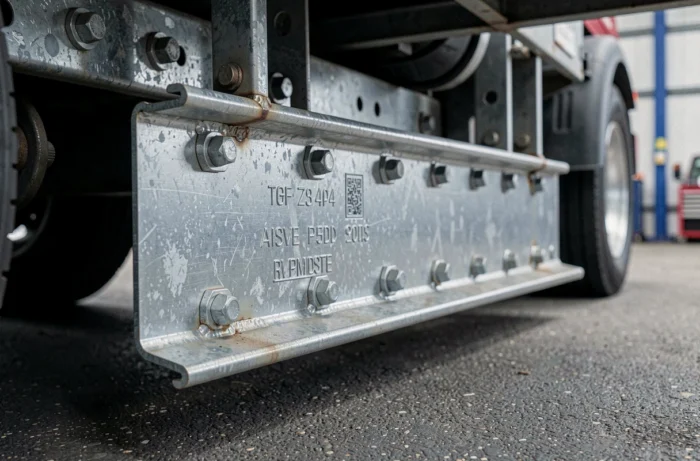
Limits of Compliant Bars in Real Impact Scenarios
An R58-03 approved bar meets the regulatory testing thresholds. This does not mean that it withstands all accident scenarios. Euro NCAP has published test results showing that compliant rear protections deformed during a collision at 56 km/h.
Under the same conditions, protections meeting the voluntary American IIHS TOUGHGUARD standard performed better. The gap between the two standards illustrates the fact that the European standard sets a safety floor, not a ceiling.
Euro NCAP also noted that automatic braking systems detect real trailers less effectively than the standardized targets used in the laboratory. Container or curtain trailers, whose rear silhouette is less readable for sensors, pose detection difficulties. Therefore, the physical protection of the bar remains the last line of defense in these situations.
Technical Inspection and Risks of Non-Compliance for Heavy Goods Vehicles
During the technical inspection of an industrial vehicle, the condition of the anti-intrusion bar is one of the points checked. An absent, deformed, poorly fixed, or blocked bar in the raised position on a tipping body constitutes a reason for re-inspection.
The consequences go beyond just the technical inspection. In the event of an accident, a non-compliance issue with the bar engages the responsibility of the vehicle owner. The bodybuilder who performed the installation may also be implicated if the manufacturer’s manual was not followed.
Regular checks of the condition of the fixings, the absence of structural corrosion, and the proper functioning of the lifting mechanism (when it exists) are part of preventive maintenance practices to be integrated into the vehicle’s maintenance plan.
The European regulatory framework, reinforced by Regulation 2019/2144, aims to broaden passive safety requirements for new industrial vehicles. The results published by Euro NCAP show that the current thresholds of R58-03 protect in standardized test scenarios but leave room for improvement in the face of higher-speed collisions. For fleet managers, regulatory compliance remains the minimum requirement, not the target to achieve.