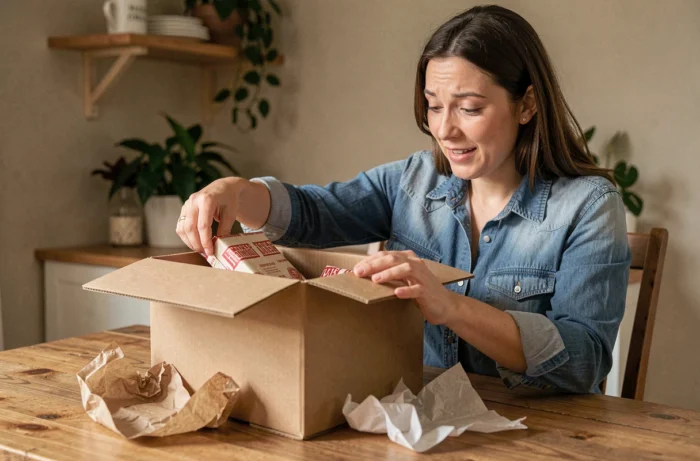
Every year, carriers accumulate significant volumes of unclaimed packages. Address errors, unreadable labels, recipients absent for too long: these goods eventually change their legal status and feed into a resale market that attracts both the curious and professional resellers. The phenomenon, amplified by unboxing videos on social media, deserves closer examination before pulling out the credit card.
Lost packages and NPAI packages: a legal distinction that changes everything
The term “lost package” covers very different realities depending on the sales channel. A NPAI package (Does Not Live at the Address Indicated) is a shipment returned to the sorting center because the recipient could not be identified. A truly lost package, on the other hand, has disappeared in the logistics chain without either the sender or the recipient being able to locate it.
In maritime transport, the situation is even more regulated: the carrier cannot freely sell unclaimed goods. A legal procedure may be necessary before any transfer. This legal constraint does not directly concern the final buyer, but it should prompt a simple question to the seller: on what basis does he hold these lots?
Serious platforms specify the origin of their goods (e-commerce returns, logistical surpluses, packages not delivered by a specific carrier). Those that only use the generic label “lost packages” without detailing the source deserve more caution. To delve deeper into the topic of supply chains, the Scoopium.fr website to visit lists the main sources of unclaimed packages accessible in France.
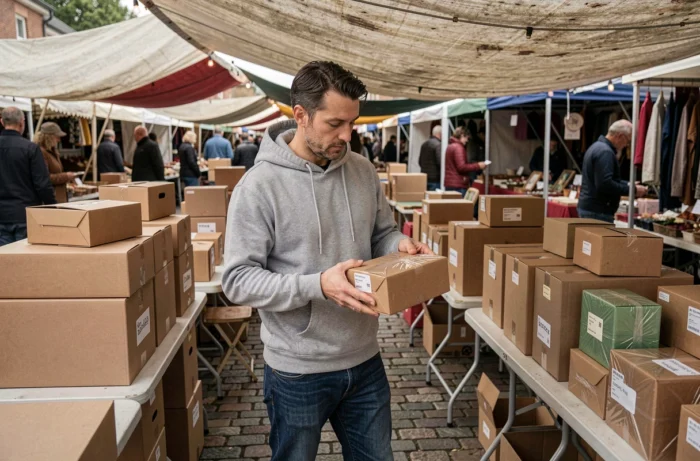
Weight purchase or sealed package: comparing two sales models
The majority of online offers provide lots sold by weight. The price then applies to the gross weight of the boxes, including packaging. Other sellers market individual packages that are still sealed, with a fixed unit price. These two formats do not offer the same level of transparency at all.
Weight lots: volume and uncertainty
A weight lot groups several items in the same shipment. The seller has already opened, sorted, and reconstituted the lot. There is no guarantee that the most interesting products have not been removed beforehand. The prices charged are around a few dozen euros per kilogram, but the actual value of the contents remains uncertain.
Sealed packages: the bet on intactness
A package that is still closed, with its original shipping label, offers superior traceability. One can sometimes identify the carrier, the size of the package, or even the type of goods based on the external markings. The unit price is generally higher, but the buyer at least knows that no prior sorting has taken place.
Before choosing between these two options, check if the announced price includes shipping costs. For a lot of several kilos, shipping fees can represent a significant portion of the total budget.
Warning signals and reliability criteria for buying lost packages online
The lost package market also attracts unscrupulous sellers. A few checks can help filter offers before ordering.
- The seller displays a SIRET number or a verifiable business identification. As a professional, he is subject to the rules of the consumer code, including the right of withdrawal for online purchases.
- Customer reviews are available on third-party platforms (Google, Trustpilot), not just on the seller’s own site.
- The general terms and conditions specify the return policy and complaint procedures. In case of a dispute, it is the seller’s status that determines the remedies, not the “surprise” nature of the product.
- The site has a secure payment protocol (3D Secure, PayPal). Requests for direct bank transfers to a personal account are a major warning signal.
Pop-up stores and temporary sales in shopping malls deserve the same vigilance. The physical appearance of the stand does not guarantee the legitimacy of the activity. Request an invoice and keep it.

Reselling the contents: what buyers of lost packages often forget
Some buyers of lost packages hope to resell the contents for a profit. This logic assumes the ability to identify, test, and photograph each item, then manage the sale on a marketplace (commission fees, shipping, handling returns).
Profitability depends on the time invested as much as on the purchase price. A lot bought at a low price but composed of items with no market value (generic accessories, expired products, damaged items) mainly generates work for a disappointing result.
Regular resellers who earn income from this activity usually buy in bulk from identified wholesalers, not retail from public sites. They know the most in-demand product categories and can quickly estimate the value of a lot based on its weight and origin.
Auction or fixed price: two purchasing circuits for unclaimed packages
Some sales of unclaimed packages go through an auction system, especially when the lots come directly from postal operators or carriers. The final price can rise quickly if several buyers are interested in the same lot.
Fixed price sites, on the other hand, offer stable pricing grids. The advantage is the predictability of the budget. The downside is that the most attractive lots sell out within hours, prompting impulsive purchases without prior verification.
In both cases, the contents remain unknown. The difference lies only in the pricing mechanism and the level of competition among buyers.
Buying lost packages remains an activity where randomness prevails. Checking the origin of the lots, understanding the sales model (weight or unit, auction or fixed price), and keeping proof of purchase are the only concrete levers to limit unpleasant surprises. Consumer law protects the buyer against a professional seller, even when the product is presented as a surprise.