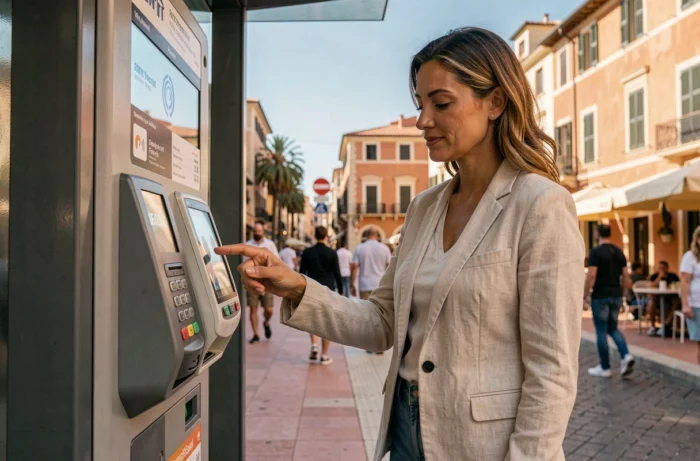
Nice served as a national testing ground for contactless payments as early as 2010, with the Cityzi project backed by several banks and telecom operators. More than a decade later, the city continues to integrate EMV terminals into its transport, parking and retail infrastructure.
Contactless payments in Nice are about more than a quick tap at the checkout: they involve different technical processes depending on the payment method used—a physical card, phone or smartwatch—with varying limits and authentication mechanisms.
Physical card, phone, smartwatch: three distinct payment methods in Nice
It is misleading to talk about contactless payments as a single technology. In Nice, someone paying for a purchase by tapping a bank card on an EMV terminal follows a different process from someone validating a transit ticket on their phone through the Lignes d’Azur app.
Physical contactless bank cards are still subject to a €50 limit per transaction. Above that amount, the terminal asks you to insert the card and enter your PIN. Mobile wallets (Apple Pay, Google Pay, Samsung Pay) can exceed this limit because biometric authentication—fingerprint or facial recognition—replaces the PIN. This distinction affects how contactless payments work in practice, depending on the payment method.
For public transport, Lignes d’Azur lets Android users buy and validate tickets directly in the app. On iPhone, the app can be used to top up a physical contactless card, but not to validate a ticket using the phone alone. And the EMV terminals in Nice installed on buses do not accept bank cards on board: drivers do not have payment terminals. Tickets must be purchased from vending machines or online.
These differences explain why a tourist accustomed to using contactless bank cards in their home city may find themselves stuck at a Nice ticket validator that only accepts the local transit card.
PIN requests and EMV security: what actually happens at the terminal
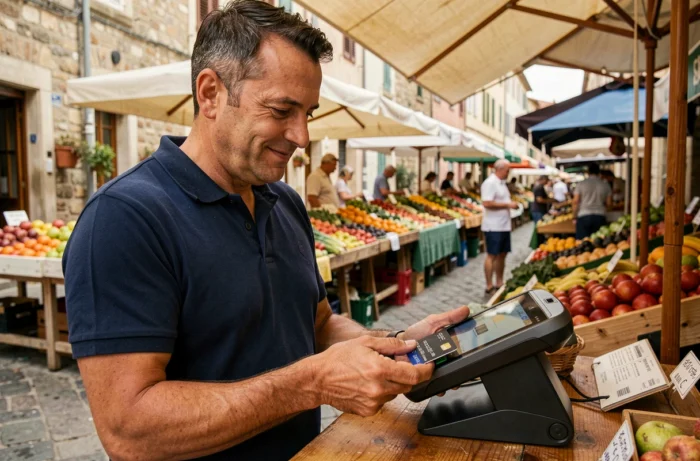
The EMV standard does more than authorize payments. It also determines when the terminal requires additional verification. A PIN request is not random: it is based on a calculation that takes into account the transaction amount, the total of previous contactless purchases and the settings defined by the issuing bank.
In practice, even for transactions under the €50 limit, a terminal may ask for a PIN if the number of consecutive transactions without authentication exceeds a threshold set by the bank. The European PSD2 regulation requires this periodic verification to reduce the risk of card theft.
This mechanism can lead many users in Nice to think something has gone wrong. A contactless payment declined at a car park or shop does not mean the terminal is faulty: the terminal is applying the EMV security rules set by the issuing bank.
Physical cards and mobile wallets: protection against fraud
Physical contactless cards remain vulnerable to close-range skimming, although the actual risk at short range (less than four centimetres) is low under normal conditions. RFID-blocking sleeves prevent NFC communication when the card is stored inside them.
Mobile wallets add a layer of security that physical cards do not offer: the card number is never sent to the terminal. It is replaced with a unique token for each transaction. If the terminal is compromised, any data captured cannot be used.
- Physical contactless card: €50 limit, PIN requested periodically, card number sent to the terminal
- Mobile wallet (phone or smartwatch): no fixed contactless limit, biometric authentication for each payment, card number tokenization
- Lignes d’Azur transit card: closed-loop system, can be topped up online or at vending machines, not directly linked to a bank account when validating on board
Contactless payments on Nice’s public transport: the state of the Lignes d’Azur network
The transport network in the Nice metropolitan area has not adopted the London model, where a standard bank card can be used as a transit pass across the entire network. Lignes d’Azur uses a dedicated card system, with digital options that vary depending on the phone’s operating system.
On Android, the app lets users buy and store a ticket, then validate it directly at a bus or tram validator. On iPhone, integration is partial: the app can be used to buy and top up tickets, but physical validation still requires a Lignes d’Azur contactless card.
This difference between Android and iOS is not unique to Nice, but it is particularly noticeable in a tourist city where international visitors, many of whom use iPhones, expect a seamless experience. The recent addition of the Lignes d’Azur card to iPhone through the native wallet could help close this gap, but the rollout is still underway.
EMV terminals and local businesses in Nice: adoption and limitations
The CIEVP project, funded 85% by European funds for a total of 117 384 euros, enabled the installation of 37 totems, 15 NFC plaques and 19 Beacon beacons between the seafront and the city centre. These devices are used for more than just payments: they also provide tourist information and help users locate services.
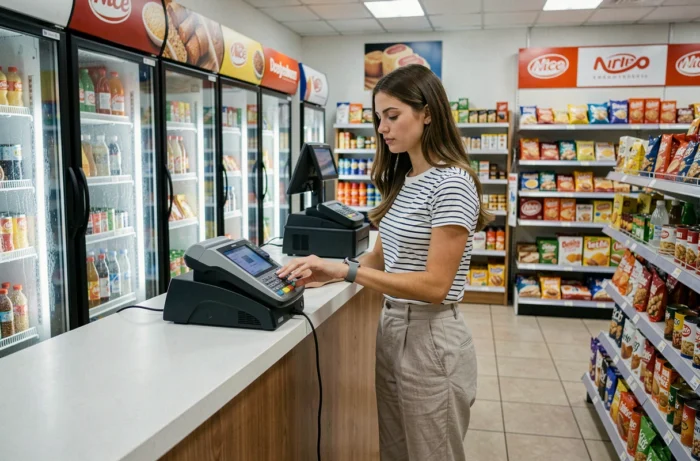
For businesses in Nice, the question is no longer whether to accept contactless payments, but which terminal to choose. The latest-generation EMV-compatible terminals accept Visa and Mastercard cards, as well as mobile wallets, through a single NFC reader. Equipment costs and bank fees remain the main barriers for very small businesses.
The exact share of contactless transactions in Nice’s retail sector is not published at city level. The national trend is clear: most in-store payments are now contactless. As a historic pilot city, Nice is naturally among the leaders in adoption, driven by a steady flow of tourists accustomed to this payment method.
Contactless payments work in Nice, but not consistently everywhere. The payment method, the transport network and the issuing bank’s rules can create very different experiences for what seems like the same simple gesture. Understanding these differences helps prevent unexpected declines and makes it easier to choose the right option for each situation.