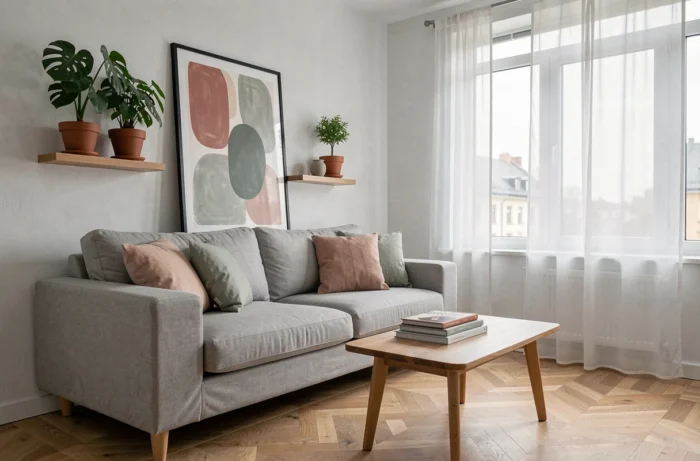
Decorating a small apartment on a tight budget means working out what genuinely changes the feel of a room—and what is simply unnecessary. The difference is clear between updates that transform a space for just a few dozen euros and those that quickly cost several hundred.
74% of French people bought or sold a second-hand item in 2025, according to 60 Millions de consommateurs (February 2026), while second-hand furniture accounted for just 1.4% of the furniture market in 2023, according to Le Journal des entreprises. This gap points to an underused opportunity for anyone looking to rethink their interior without breaking the bank.
Small-apartment decorating budget: where the money really goes
Not all decorating expenses are equal. Some can change how a space looks for a modest cost, while others absorb most of the budget without delivering a proportional impact.
| Item | Indicative cost | Visual impact | Reversible for renters |
|---|---|---|---|
| Wall paint (one room, 10-15 m²) | Low (materials only) | High: changes the perceived brightness and proportions | Yes, provided you restore a neutral shade before moving out |
| Textiles (curtains, cushions, rugs) | Low to medium | Medium to high: absorbs noise and defines zones | Yes, entirely removable |
| Lighting (lamps, string lights, clip-on spotlights) | Low | High: reshapes the atmosphere of each room | Yes, no drilling needed with floor or clip-on models |
| Second-hand furniture, sourced and repainted | Low to medium | High: a distinctive piece with an immediate effect | Yes, personal furniture |
| Floor covering (repositionable adhesive vinyl) | Medium | Medium: unifies the room and conceals worn flooring | Yes, if it can be repositioned and removed without leaving marks |
| Fixed partition or glass wall | High | High: restructures the space | No, the landlord’s approval is required |
Paint and lighting offer the best balance between cost and perceived transformation. By comparison, investing in a new designer sofa for a studio apartment often uses up half the total budget without changing how the space feels.
A contemporary decorating service for small apartments can help you prioritize these choices before making any purchases, based on the available floor space and whether you rent or own.
Reversible rental decor: what tenants can do without permission
Refreshing paintwork, changing a light fixture or applying removable wall covering are all considered improvements. Altering the structure of the property or its fixed fittings—such as removing a partition, replacing a radiator or changing an interior door—is considered a modification. Any modification requires the landlord’s written consent, and without it, the landlord can require the property to be restored when the tenant moves out.
This legal distinction shapes any decorating strategy for a small rental. It points toward removable or easily reversible solutions.
Improvements that do not require permission
- Repaint the walls in a contemporary shade (light gray, terracotta or sage green), provided you restore a neutral color before moving out
- Apply repositionable non-woven wallpaper to one wall to create a focal point without damaging the surface
- Install wall shelves with lightweight fixings (Molly bolts or adhesive systems), filling the holes before moving out
- Replace the handles on doors or built-in kitchen cabinets, keeping the original ones so you can put them back
Work that requires the landlord’s written consent
Installing a floor-to-ceiling steel-framed glass partition, removing or moving a wall, modifying the electrical system or changing glued-down flooring all count as modifications. Tenants must obtain written permission before starting this type of work.
In practice, tenants who focus their budget on paint, textiles and lighting can achieve a result comparable to a light renovation, without the legal risk.
Second-hand furniture and reuse: an underused way to save
Buying second-hand is widespread in France, but furniture is still rarely part of the trend. Second-hand goods accounted for just 1.4% of the furniture market in 2023. For anyone decorating a small apartment, this imbalance is an opportunity: there is plenty of second-hand furniture available at low prices, and competition among buyers is still limited compared with other categories such as clothing and electronics.
A thrifted piece of furniture—a chest of drawers, coffee table or vintage sideboard—repainted in a contemporary matte shade can make a visual impact that budget new furniture cannot. Its distinctive character gives a room its own identity instead of repeating the same standardized interiors.
The AGEC law of February 10, 2020, helped structure this sector by requiring eco-organizations to allocate at least 5% of their contributions to funds dedicated to reuse and repurposing. This regulatory framework supports a growing network of reuse centers and specialist platforms, making quality furniture more accessible at reduced prices.
Making the most of a studio or narrow living room: choices that change how it feels
In a space under 30 m², every decorating choice comes down to centimeters. A large mirror placed opposite a source of natural light can visually double the depth of a room. This optical trick remains the most cost-effective way to make a space feel larger without altering its structure.
Light colors on the walls and ceiling increase light reflection. An accent wall in a deeper shade—such as midnight blue or forest green—adds depth without darkening the whole room, as long as you limit it to a single wall.
Multifunctional furniture—a bench with built-in storage, a drop-leaf table or a loft bed—frees up floor space. In a studio, visible floor space is the clearest indicator of how spacious a room feels: the more floor you can see, the more livable the room appears.
Layered lighting—a reading lamp, a low-hanging pendant above the table and an LED strip behind a piece of furniture—works better than a single ceiling light, which can make a room feel flat. Using multiple light sources at different intensities visually divides even a single room into distinct zones.
The most effective choices for a small apartment are not designer furniture or premium materials. They come down to three accessible tools: light, color and clear floor space. By mastering these three elements and choosing reversible solutions and second-hand furniture, renters can turn a cramped space into a contemporary home without overspending.