
The stroller market offers hundreds of models, from budget options to premium modular systems. The European standard EN 1888, whose French versions were updated in 2022, distinguishes strollers designed for children weighing up to 15 kg from those intended for children weighing up to 22 kg. This regulatory baseline guarantees a minimum level of safety, but it is not enough to help you choose between two compliant models.
Since December 13, 2024, the European GPSR has also introduced new information requirements for online sales: product identification, manufacturer contact details, and safety warnings. These requirements change how parents can check what they are buying, especially when dealing with a third-party seller.
Buying a stroller online: what the GPSR means for parents
Buying a stroller on a marketplace or from a little-known retailer raises a question rarely addressed in buying guides: how can you check that the product is compliant before it arrives?
The GPSR, which has applied since December 2024, requires online product listings to display the manufacturer’s contact details and safety warnings directly on the product page. In practice, a listing that does not mention the manufacturer’s name, the standard reference, or usage precautions is a red flag. On rouletitine.fr, product pages let you check this information before placing an order.
The legal guarantee of conformity applies regardless of the sales channel, but return and support policies vary by seller. Before buying online, you can complete these three checks in under two minutes:
- The product page lists the manufacturer’s name and address (or the details of the responsible person in the EU if the manufacturer is based outside Europe).
- The EN 1888 standard is referenced in the technical specifications, along with the corresponding weight range.
- Safety warnings (minimum age, maximum weight, usage restrictions) appear on the product page, not only in the manual supplied with the product.
A seller that provides none of this information is not meeting its regulatory obligations. It is better to move on to the next model.
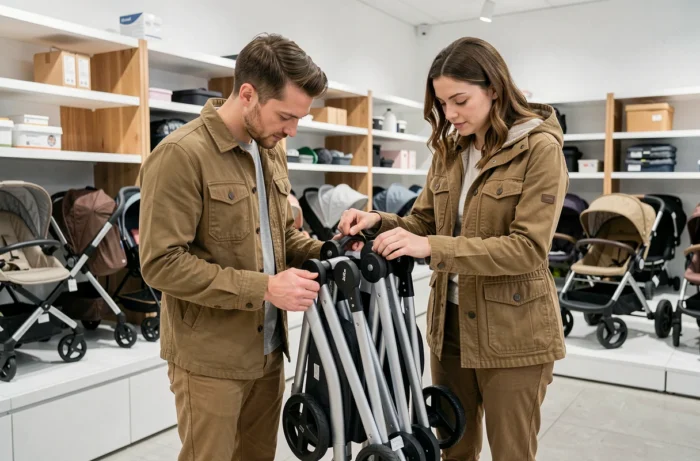
Stroller carrycots and baby sleep: a common misconception
Many parents use a stroller carrycot as a place for their baby to nap for extended periods, or even as a travel cot when they are away from home. This practice needs clarification.
A baby should only sleep in a carrycot if the manufacturer explicitly states that it is suitable for this purpose. The surface must be flat and firm. A soft, curved, or excessively padded carrycot does not meet these requirements, even if the baby seems comfortable sleeping in it.
Specialist infant sleep resources also highlight the risk of overheating. Covering the stroller with a blanket or muslin to shield the baby from the sun reduces airflow and can raise the temperature inside the carrycot. The manufacturer’s instructions are the definitive source for finding out whether a specific model is suitable for sleep and under what conditions.
This has a direct bearing on your initial choice. Parents planning long days outdoors should check this information in the specifications before buying, not afterward.
Wheels and frame: choose based on the terrain you actually use
Competitor guides often group strollers by category (city, all-terrain, travel). This approach has its limits: most parents switch between sidewalks, public transport, and park paths.
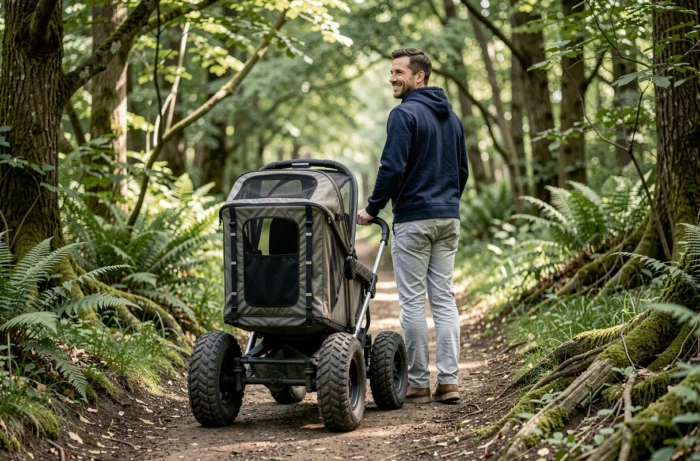
Wheel diameter determines how easily a stroller can get over obstacles. Small-diameter wheels work well on smooth surfaces but can get stuck on a damaged sidewalk or gravel path. Larger, air-filled wheels absorb bumps more effectively. The trade-off is that the stroller takes up more space when folded.
The suspension system matters just as much as wheel size. Suspension built into the frame absorbs vibrations transmitted to the child, helping them stay asleep during walks. Not all models have it, even in higher price ranges.
Before choosing, it helps to list your most frequent journeys: the distance from home to daycare, the type of surface, and how many steps you need to climb. A compact model weighing less than 7 kg is easy to handle on a bus, but its small wheels will make a walk on a forest trail uncomfortable.
Cabin strollers on planes
A model described as “cabin-sized” by its manufacturer is not automatically accepted in the cabin by every airline. Permitted dimensions vary by airline, ticket type, and sometimes even by flight. The only reliable approach is to measure the stroller when folded, including accessories, then check the rules of the carrier actually operating your flight. An oversized stroller will have to go in the hold, defeating the purpose of its compact design.
Stroller safety criteria: beyond the EN 1888 standard
Compliance with the EN 1888 standard certifies that a model has passed tests for stability, fastener strength, and material durability. However, two compliant strollers can offer very different levels of safety in everyday use.
The harness is the first thing to inspect. A five-point harness with a crotch strap prevents the child from sliding forward. The backrest height and seat depth should suit the child’s size, not just their weight. A seat that is too wide for an infant will not support their hips properly.
The braking system should also be checked by hand in the store or as soon as the stroller arrives. A parking brake that disengages too easily poses a risk on a slope, even a slight one. Some models have a central brake operated with one foot, while others have two independent brakes on the rear wheels.
The standard sets a minimum level of safety. Real-world use, however, depends on details that can only be assessed by carefully examining the model: the quality of the harness stitching, the firmness of the folded-position lock, and the absence of pinch points within a child’s reach.
Choosing a stroller means committing to several years of daily use. Comfort and maneuverability remain key considerations, but product traceability and the ability to verify compliance are just as important, especially when buying outside a specialist store.
Checking the full technical specifications, identifying the manufacturer, and reading the warnings before placing an order takes just a few minutes. It is the most effective way to rule out models that do not belong on your shortlist.