
The decree of February 26, 2025 established the framework for refresher training for nursing assistants who qualified before the 2021 curriculum reform. Three mandatory modules structure the program: assessing general health, providing care in acute situations, and identifying at-risk situations.
At the same time, the decree of December 24, 2025 amended Article R. 4311-7 of the French Public Health Code, with the changes due to take effect no later than June 30, 2026. Together, these regulatory changes are reshaping the scope of nursing assistants’ practice, but raise a practical question: how can the rules be translated into day-to-day practice in a care unit?
Nursing assistant care protocols: what the certificate does—and does not—authorize
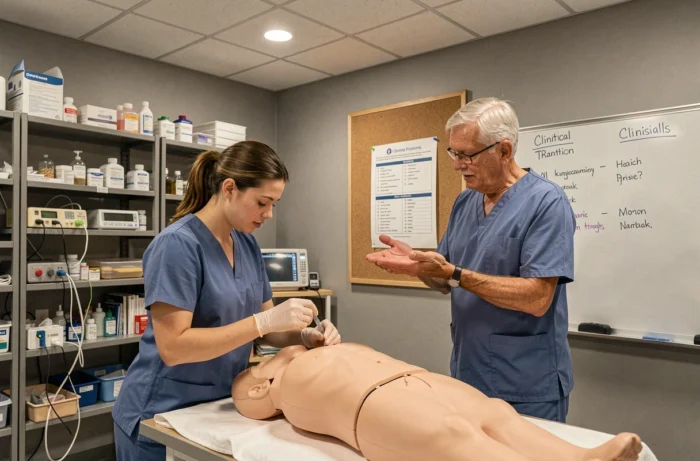
A common misconception is that a training certificate gives the holder the green light to perform every technical procedure listed. The reality is more nuanced. The training provider Assisteal specifies that all three modules are assessed through practical simulations and case studies. The certificate is issued only if all three modules are passed. If a participant fails one module, they receive a certificate of attendance, which does not grant the same scope of practice.
This distinction has direct consequences. A nursing assistant who holds a certificate of attendance without having passed all the modules cannot claim the same level of regulatory competence. The employing organization must therefore check the exact status of the document before including the professional in a technical care protocol.
For a detailed overview of the procedures involved and the expected competencies, the new 2026 nursing assistant framework outlines each competency area covered by these protocols.
Nursing assistant refresher training: three modules, one care process

The program published by ANFH goes beyond teaching isolated procedures. Each module combines technical content with transferable skills that change the very nature of nursing assistants’ work.
- The general health assessment module covers the analysis of measurements (vital signs, skin condition, clinical warning signs) and the documentation of these observations in the care record.
- The acute care module explicitly includes collaboration with the nurse and the multidisciplinary team, as well as assessing the quality of care provided and adjusting the intervention if necessary.
- The at-risk situations module trains participants to raise concerns in a structured way and adapt their intervention as the patient’s clinical condition changes.
This sequence signals a shift in approach. Nursing assistants no longer simply carry out a procedure based on a fixed prescription: they become part of a care process that includes assessment and adjustment. Knowing when to alert the nurse, and according to which criteria, becomes a competency in its own right and is assessed during training.
Nursing support and escalation criteria in acute situations: the missing link
The training decree sets out how individuals can develop their skills. But it says nothing about the practical conditions for implementing them in a care unit. During a night shift with reduced staffing, who checks that a trained nursing assistant can reach an available nurse to validate a decision in an acute situation?
The amendment to Article R. 4311-7 of the French Public Health Code, introduced by the decree of December 24, 2025, concerns nursing procedures in emergency situations. This text does not, by itself, provide a list of procedures transferred to nursing assistants. Checking the regulations in force rather than relying on a generic list of procedures remains essential for every nurse manager drafting a unit protocol.
Training time illustrates this gap. The decree sets out the curriculum, but each organization must arrange staff cover for the duration of the program. In facilities where staffing ratios are already stretched, these logistical constraints can delay access to training by several months.
Funding nursing assistant training: what the decree does not cover
The decree of February 26, 2025 establishes a training program that leads to a certificate, but it does not, by itself, establish eligibility for CPF funding. For nursing assistants working in public facilities, funding generally comes through the employer’s training plan, often via ANFH. In private facilities, funding arrangements vary depending on the relevant OPCO.
For nursing assistants in private practice or looking for work, the situation is less clear. Individual training rights do not automatically apply to this type of refresher program. Checking funding options with the employer or training provider before enrolling can help avoid an unpleasant surprise.
This lack of clarity has a measurable consequence: nursing assistants who work far from major hospitals—where information is shared through nurse managers and continuing education departments—may find out about funding arrangements too late.
Turning protocols into practice: the role of the nurse manager
Regulations establish the framework. The certificate confirms a level of competence. But it is at the unit level that the real impact of these new procedures is determined. The nurse manager—or care coordinator, depending on the organization—plays a pivotal role.
Their responsibilities span several areas: checking that every nursing assistant in the unit holds a certificate confirming successful completion (not merely attendance), drafting or adapting technical care protocols to include escalation criteria and procedures for contacting a nurse, and ensuring that these protocols are workable given actual staffing levels.
A protocol requiring immediate access to a nurse is not operationally viable if the nurse on duty is covering three units. Aligning certified individual competencies with the collective organization of care is the real challenge in implementing technical procedures under protocol in 2026.
Refresher training for nursing assistants is therefore about more than completing a course. It requires every organization to reorganize its protocols, schedules, and escalation pathways, or risk creating a gap between regulatory competence and the actual ability to practice.