
A travel journal, before becoming a pretty object on a shelf, serves a very practical purpose: it helps you organize what you saw, tasted, missed, and discovered by chance. Keeping a travel journal means turning fleeting impressions into lasting reference points. And those reference points become the raw material for your next trips.
Hybrid travel journals: when paper meets digital
Have you noticed that a paper journal and a note-taking app on your phone aren’t useful at the same time? Paper works well in the evening, back at the hotel, when you can take a moment to reflect. Your phone, on the other hand, is useful in real time: taking a photo of a menu, saving a route, or recording a local resident dictating an address.
A recent concept combines these two uses. Some physical journals include a QR code that links to an associated digital space. You can stick tickets and sketches in the paper journal, then scan the code to find the GPS route, a restaurant’s contact details, or museum opening hours saved on your phone.
This idea of a hybrid paper-and-digital journal is more than a gimmick. It solves a common problem: paper journals end up in a drawer, while digital notes get lost among a stream of notifications. The QR code bridges the two, as long as you start using it from the first day of your trip.
Some tourism providers even offer this type of personalized journal as part of organized trips, with built-in messaging for communicating with local businesses and residents. It goes beyond a simple keepsake: the journal becomes an active travel companion. On normandy-unpacked.com, the approach is similar, with local experiences taking priority over a standardized catalog.

Choosing the right format for your travel journal
Your choice of format shapes what you’ll put in your journal. A notebook that’s too small can discourage longer entries. One that’s too large won’t fit in a backpack. The size, paper weight, and binding matter just as much as your desire to write.
Paper: choosing the right weight and binding for your trip
If you want to draw or add watercolor paintings, you’ll need paper that’s thick enough not to buckle. Spiral-bound notebooks lie flat, making it easier to write on your knee or at a wobbly café table.
Sewn-bound notebooks hold up better over time, but they’re less suited to repeated handling in damp conditions. Heading to the tropics? Choose a spiral binding. Traveling in temperate Europe? A sewn binding will work well.
Digital: dedicated apps or standard note-taking apps
Some travel journal apps offer specialized features:
- Automatic geotagging of notes, so you can find where you were when you wrote a particular entry
- Direct photo imports from your phone’s gallery, organized chronologically
- Selective sharing with other travelers or loved ones, without posting on social media
Your regular note-taking app—the one already installed on your phone—will work just as well. The tool matters less than writing regularly. Three lines every evening in a basic app are better than a sophisticated journal left blank.
Filling your travel journal: a simple three-stage approach
The most common reason people get stuck in front of a blank journal is the fear of the blank page. You want to do it right, put it off, and end up with a trip that’s over before you’ve written a single line. The solution is simple: break the writing process into three distinct stages.
Before you leave: set the scene
Write down the practical details that will shape your trip. No need to write full sentences—a list is enough. Dates, stops, accommodation names, booking numbers. This basic framework will give you something to build on once you’re there.
Add one or two personal questions you’d like to answer during your trip. For example: “Which local dish will I remember?” or “Which place will make me want to come back?” These questions guide your attention without limiting it.
During the trip: capture without filtering
The trap is trying to write beautiful sentences. While you’re traveling, jot down the facts:
- The name of a street, a dish, or someone you met
- A physical sensation (the heat of a covered market, the sounds of a fishing port)
- A specific visual detail rather than a general impression (“peeling ochre walls” is better than “pretty village”)
- The cost of a meal, the length of a journey, or opening hours confirmed on the spot
Five minutes a day is enough to build up material. The goal isn’t to write a full account, but to collect fragments you can piece together later.

After you return: connect the dots and add illustrations
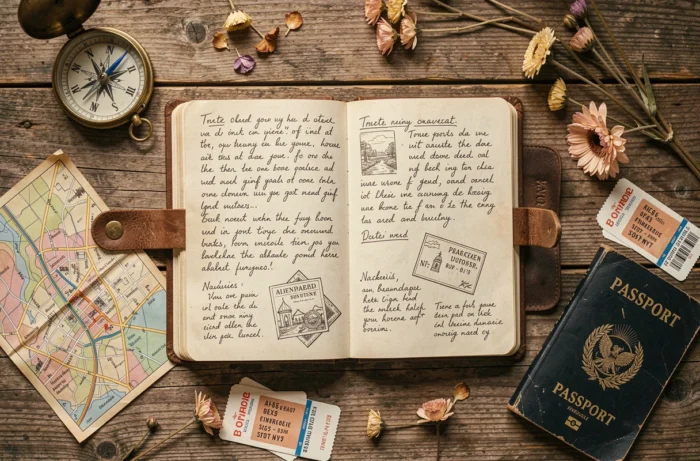
This is when your journal takes its final shape. You reread your rough notes, sort through your photos, and stick in admission tickets or postcards you picked up along the way. Looking back after some time has passed helps you distinguish what really matters from what was just an anecdote.
Some travelers add sketches or watercolors at this stage. Others prefer to print a few Polaroid-style photos and stick them next to their handwritten notes. Your travel journal becomes one of a kind because it brings different formats together in one place.
Personal data and digital travel journals: an often-overlooked issue
As soon as a travel journal uses a connected app, personal data becomes a consideration. Geolocation, photos containing metadata, login credentials: this information passes through servers, and its processing may be subject to the GDPR for European users.
Why should you care? Because QR code scan logs, for example, may contain timestamped location data. If you use a hybrid journal with a QR code, check that the provider clearly explains its data processing policy.
Not all travel journal apps are transparent about this. Before choosing one, check whether it stores your data locally (on your phone) or on a remote server. Local storage offers better privacy, but it also puts you at risk of losing your data if your phone is stolen or damaged.
This isn’t just a technical detail for specialists. It’s a practical question: do you want your routes and travel photos hosted on a server whose location you don’t know? Your answer will help you choose the right tool.
Travel inspiration: turning old journals into plans for new discoveries
A finished journal isn’t just for reminiscing. Reread it with a pen in hand and jot down in the margins what you’d do differently. A restaurant that was closed when you visited, a hike you had to cancel for lack of time, a neighborhood you rushed through: these are ideas for your next trip.
Rereading your journal this way turns it into a planning tool. You’ll start to notice patterns in your preferences: you’re always drawn to food markets, you keep returning to the same kinds of landscapes, or you consistently write down the names of local wines.
These patterns reveal your travel priorities better than an online questionnaire. They help you choose your next destination based not on a ranking or a trend, but on what genuinely made an impression on you.
A travel journal doesn’t have to be perfect to serve this purpose. A few hurried notes, a map folded into quarters, a crumpled bus ticket: these fragments are enough to piece a trip back together and imagine the next one. The regular habit of writing, even just a little, matters more than the literary quality of the result.