When you type “maori tattoo meaning” into a search engine, the results mostly return lists of symbols: turtle, tiki, koru, shark. Each motif receives a short definition, often identical from one site to another. What these lists do not allow us to measure is the gap between a freely composed Polynesian-inspired motif and a tā moko linked to a specific identity.
This article compares the two categories, their concrete implications, and the criteria to check before validating a design.
Tā moko and kirituhi: two categories of Maori tattoo to distinguish
The term tā moko refers to the traditional tattoo of the Māori of Aotearoa (New Zealand). It carries information about lineage, status, and familial connections specific to the tattooed person. Its design generally involves a dialogue with a practitioner trained in this tradition.
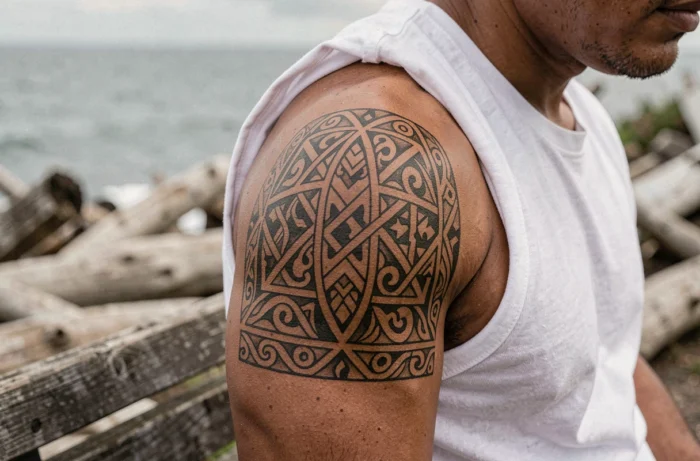
The word kirituhi describes a creation inspired by Māori culture intended for people who are not Māori. It uses visual vocabulary (spirals, curved lines, geometric patterns) without claiming the identity dimensions of tā moko.
| Criterion | Tā moko | Kirituhi |
|---|---|---|
| Recipient | Person of Māori descent | Any person |
| Identity content | Whakapapa (genealogy), status, family ties | Aesthetic and personal values |
| Design | Dialogue with a tohunga tā moko or recognized practitioner | Tattoo artist specialized in Polynesian motifs |
| Facial placement | Common (moko kauae for women, moko on the entire face for men) | Rare and discouraged without cultural connection |
| Technique | Traditional (uhi, comb) or machine, depending on the practitioner | Machine almost systematically |
This distinction changes the question to ask the tattoo artist. Before asking “what does this motif mean?”, one must know under what name the project is presented: tā moko or kirituhi. A serious tattoo artist asks this question first, as it conditions the composition, the allowed motifs, and the creation process. Exploring the meaning of the Maori tattoo allows us to measure how much the models copied online erase this boundary.
Polynesian motifs on the Internet: what image banks do not show
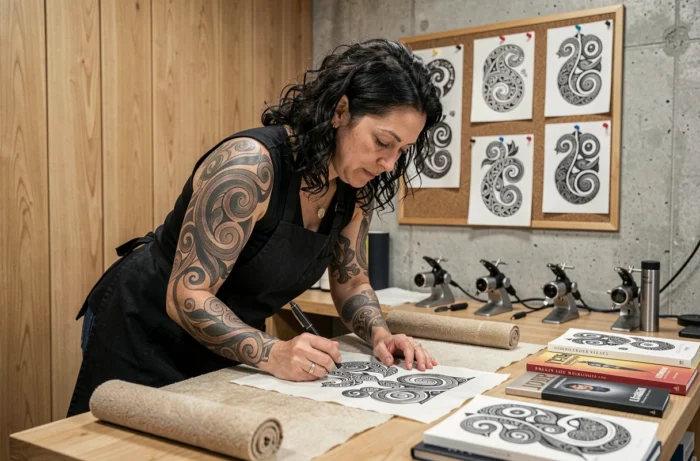
The majority of “Maori designs” available online are hybrid compositions. They mix elements from distinct traditions: Māori spirals, Marquesan motifs, Samoan figures. The result resembles a Polynesian tattoo without corresponding to any specific tradition.
The problem is not only aesthetic. A motif taken out of its context loses its narrative function. In Māori tradition, the placement on the body, the orientation of the lines, and the relationship between elements tell the story of the person. A koru placed on the right shoulder does not “say” the same thing as a koru integrated into a facial composition.
Three signals allow us to evaluate the reliability of a design found online:
- The source specifies the cultural origin of the motif (Māori, Samoan, Marquesan, Tahitian) instead of using the generic term “Polynesian”
- The creator of the design is identified, ideally an artist trained in the relevant tradition
- The motif is presented as a basis for discussion with the tattoo artist, not as a model to be reproduced exactly
If none of these three conditions are met, the design falls under generic kirituhi at best, and cultural plagiarism out of context at worst.
Revitalization of tā moko: a living practice, not a relic
Presenting Māori tattooing as a tradition frozen in the past distorts the understanding. Since the end of the 20th century, a resurgence of tā moko accompanies the Māori cultural revival in New Zealand. Contemporary practitioners combine traditional techniques (uhi, bone comb) with modern materials, without compromising the authenticity of the approach.
This revitalization also means that the rules are evolving. Some practitioners accept to create compositions for non-Māori people under the term kirituhi, provided that the process respects a prior exchange about the intention and background of the bearer.
The case of facial moko and its practical implications
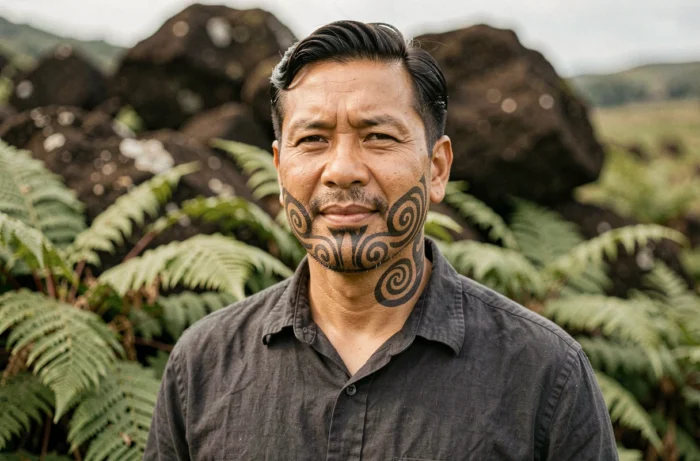
The moko kauae (chin tattoo, worn by Māori women) and the male facial moko carry strong identity dimensions. Outside of the cultural context, a facial tattoo inspired by Māori culture raises concrete questions rarely addressed in inspiration galleries.
Facial recognition systems can be disrupted by a facial moko. Research on Māori digital identity highlights that biometric devices must take these markings into account. For a person considering a facial tattoo, this means checking the implications for identity checks, unlocking systems, and official documents.
Concrete criteria for choosing a tattoo artist specialized in Māori motifs
The choice of practitioner weighs more than the choice of motif. A competent tattoo artist in Polynesian motifs does not simply reproduce a design: they adapt the composition to the body, personal history, and appropriate cultural context.
- The tattoo artist explicitly distinguishes between tā moko and kirituhi in their communication and guides the client towards the category that corresponds to their situation
- They can name the origin tradition of each element used in the composition (Māori, Samoan, Marquesan) and explain why they associate them
- They propose a multi-step design process, with a prior exchange about the desired meaning, not just about placement
- Their portfolio shows varied compositions, not repetitive reproductions of the same model applied to different bodies
A practitioner who refuses to reproduce a model found online without prior discussion is generally more reliable than a tattoo artist who accepts any reference image without asking questions.
Māori tattooing remains one of the few traditions where the meaning of the motif depends as much on who wears it as on what it represents. Checking the origin of a design, identifying the cultural category of the project, and choosing a practitioner capable of explaining each element of the composition constitute the three filters that separate a meaningful tattoo from mere surface decoration.