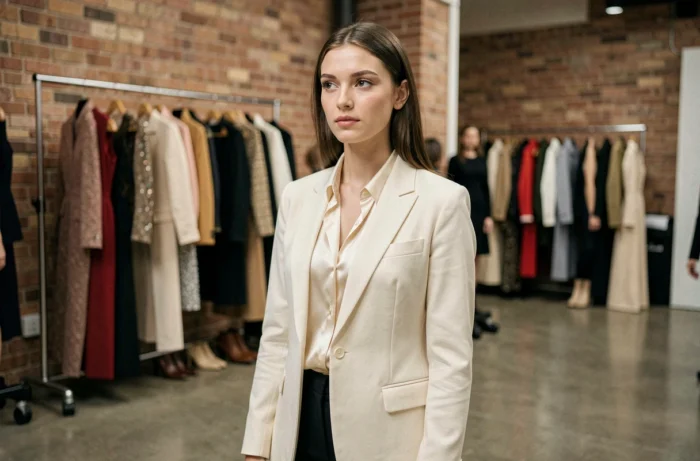
When a model goes from local castings to international campaigns in just a few seasons, the trajectory draws attention. Jenna Peij is one of those models who have fast-tracked their careers without taking the usual route through reality TV or high-profile competitions. Understanding how a career like this is built offers insight into the practical realities of working as a model in France.
Modeling in France: a legal framework that shapes careers
Before discussing success or fame, it is worth recalling a reality that many aspiring models are unaware of. In France, modeling work is presumed to be employment under an employment contract. When someone is paid for modeling work, the law considers it salaried employment, not freelance work.
In practice, agencies must hold a license and provide a financial guarantee. These requirements are not just formalities: DRIEETS (the Regional Directorate for the Economy, Employment, Labor and Solidarity) conducts inspection campaigns targeting modeling agencies. Checks cover licenses, guarantees, contracts and pay, including at fashion shows.
For a model like Jenna Peij, working within this framework means partnering with compliant agencies, which helps secure the contractual relationship. An article detailing Jenna Peij’s career on Mode Sign shows that this professional structure is not a barrier, but a foundation for building a lasting career.
The realities of modeling: what social media doesn’t show
Instagram and visual platforms make it seem as though modeling is all about polished photos and glamorous stories. Official statistics cover only models represented by French agencies. Some work falls outside these figures, particularly at off-schedule fashion shows or through informal collaborations.
This gray area creates a real problem. Undeclared models, often represented by foreign agencies, take part in events such as Paris Fashion Week without the protections of French labor law. Undeclared work behind the scenes at fashion shows remains a sensitive issue in the industry.
The skills no one lists in a portfolio
A professional model does more than pose. Managing their image requires several practical skills:
- Understanding the terms of a service contract and checking that the agency holds a valid license before signing anything
- Managing their social media presence as a professional tool, distinguishing personal content from content created under contract for brands
- Adapting their posture and expression to the type of assignment (editorial, commercial or runway), which takes regular practice
- Knowing how to negotiate the use of their image, particularly the duration and the platforms on which photos will be published
Understanding the contractual use of one’s image has become a core skill in a market where visuals spread rapidly across the web.
AI-generated models: a new challenge for real-world careers
Have you ever noticed those flawless faces in online ads without being able to tell whether they belong to a real person? AI-generated models present a new competitive challenge. These digital avatars raise direct questions about consent, image rights and compensation for real models.
For working models, this competition changes the landscape. AI can produce visuals at a lower cost, without scheduling or travel constraints. The economic appeal for brands is clear.
The difference comes down to what a human model can offer that an avatar cannot replicate: a physical presence on the runway, real-time interaction with a photographer, and the ability to convey genuine emotion in front of the camera. This human dimension is what helps protect careers like Jenna Peij’s as automation continues to grow across the fashion industry.

Building a lasting modeling career: practical strategies
A meteoric rise does not have to mean a short-lived career. Longevity in modeling depends on strategic choices made in the early years.
The agency’s role in a model’s career
Choosing an agency shapes everything: the castings a model can access, the quality of the contracts on offer, and legal protection in the event of a dispute. In France, a licensed agency provides a legal framework that informal organizations cannot guarantee. This distinction is the first thing every aspiring model should check.
Personal image and digital strategy
Models who build a consistent presence on Instagram and other social media platforms can expand their visibility beyond traditional channels. A regularly updated online portfolio, collaborations documented in photos and videos, and a clear editorial direction all help build a personal brand.
The trap is to confuse social media popularity with a professional career. Followers cannot replace a signed contract with a fashion house. Digital visibility serves as a showcase, not a substitute for agency work.
Jenna Peij’s career illustrates how online visibility can go hand in hand with a solid professional foundation. In an industry defined by constant change and fierce competition, the models who last are those who treat their careers as structured projects, not as a string of lucky breaks.