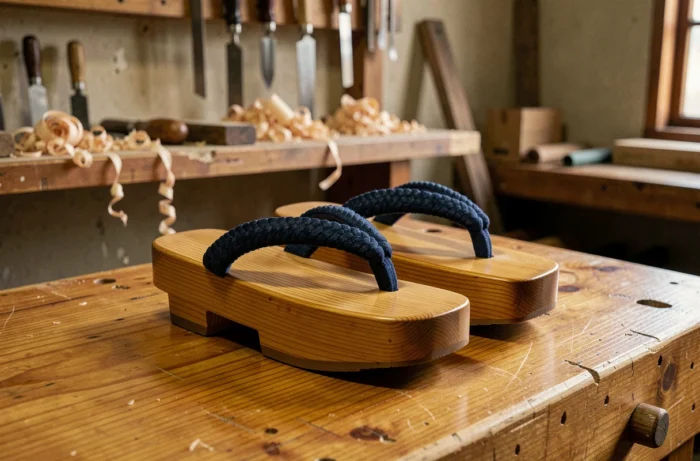
You hold a pair of geta in your hands; the wood feels smooth, and the strap is colorful. Everything seems correct. But how can you tell if these Japanese sandals are truly handmade or just mass-produced? The answer lies in a few concrete details that can be checked before purchase.
Traceability of handmade geta: what the label “Japan” doesn’t tell you
A “made in Japan” sticker is reassuring, but it doesn’t provide information about every stage of production. The final assembly may take place in Japan while the wood or hanao (the strap) comes from elsewhere.
To assess the authenticity of a pair, look for more specific information: the name of the workshop or the manufacturing region. A transparent artisan mentions the type of wood used and their assembly method. These details are rarely found on an industrial product.
Have you noticed that some product descriptions remain vague about the origin of the components? This is often a sign of a fragmented production chain. By following Kabanes’ advice, you will find concrete criteria to distinguish a truly handmade production from a simple labeled assembly.
Asking about the origin of the wood and the fabric of the hanao is not a whim. It’s the basis for an informed purchase, especially when the price exceeds that of a common sandal.
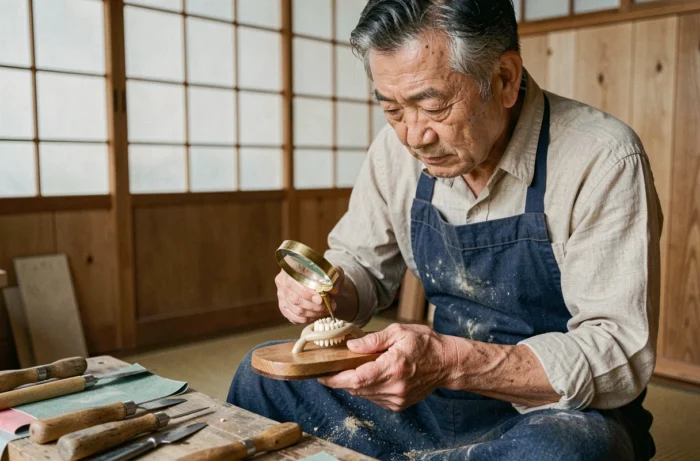
Wood, finish, and assembly: the technical criteria of a quality geta
The most telling material is the dai, the wooden base on which the foot rests. On a handmade geta, the wood grain is visible, sometimes irregular. This irregularity is not a flaw. It proves that the piece has been individually crafted.
The type of wood and its treatment
Traditional geta use lightweight woods like paulownia (kiri in Japanese). This wood absorbs moisture and remains comfortable even in hot weather. A wood that is too heavy or covered with a thick varnish often hides poor quality.
On a handmade pair, the surface of the dai may be left raw or simply polished. Run your finger over the top: you should feel the natural texture of the wood, not a plastic coating.
The ha and their attachment
The ha are the two teeth under the base. On a handmade model made of solid wood, they are often carved from the same block as the dai. This monobloc construction is a sign of lasting quality.
On an industrial product, the ha are glued or screwed separately. Turn the geta over and observe the junction between the base and the teeth. Ha carved from a single piece with the dai resist wear better.
The hanao: more than just a strap
The hanao, the fabric strap that goes between the toes, deserves as much attention as the wood. On a handmade geta, the fabric is often cotton or silk, sometimes with internal padding. The attachment to the dai goes through the wood, secured by a knot or a lacing system under the sole.
- A quality hanao features dense fabric with clean finishes at the ends, without visible threads or glue
- The internal padding (often cotton) should feel consistent to the touch, ensuring long-term comfort
- The attachment goes through the wood of the dai rather than being simply stapled on the surface, allowing for future replacement
This last point is crucial. The ability to replace the hanao distinguishes a geta designed to last. An artisan who anticipates the repair of their sandal thinks about its use over several years.
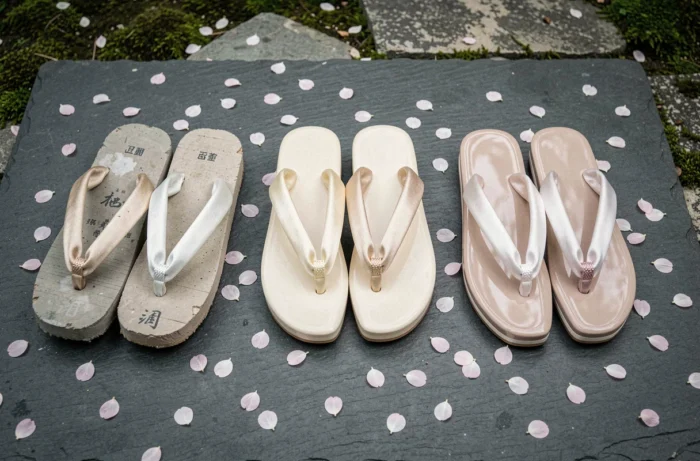
Modern geta on asphalt: handmade doesn’t mean only old-fashioned
Why should a geta look exactly like those from the Edo period to be considered handmade? This misconception leads to dismissing contemporary models that are nonetheless handcrafted with real expertise.
Some geta designed for walking in the city incorporate rubber protection under the ha. This adaptation protects the wood from asphalt without compromising the handmade construction. Evaluate the construction and intended use rather than just the classic appearance.
A model with a sole suited for urban ground can be entirely made in a Japanese workshop, using paulownia wood and a hanao made from traditional fabric. The modernity of the underside does not detract from the quality of the upper.
Repairability and maintenance: the signs of a sustainable purchase
Before buying, ask the seller a simple question: can the hanao be replaced when it wears out? The answer says a lot about the design of the sandal.
A handmade geta is designed as a repairable object. The hanao can be changed, and the ha can be sanded down if they become dull. Repairability is a quality criterion as much as the material itself.
Maintenance also depends on the finish of the wood. A raw paulownia geta does not react to water in the same way as a varnished model. A few practical precautions can extend its lifespan:
- Let the geta air dry after exposure to moisture, never near a direct heat source
- Gently brush the wood with a soft brush to remove dust without scratching the surface
- Store the geta in a dry place, preferably wrapped in fabric to avoid friction
An artisan or a specialized seller will be able to guide you on the appropriate care for the specific finish of your pair. The absence of personalized maintenance advice is sometimes an indication that the product was not designed with artisanal follow-up.
Distinguishing a handmade geta from an industrial product relies on checks accessible to everyone: transparency about the origin, the texture of the wood, the attachment of the hanao, and the possibility of repair. These details, taken together, tell the story of the sandal far better than a label.