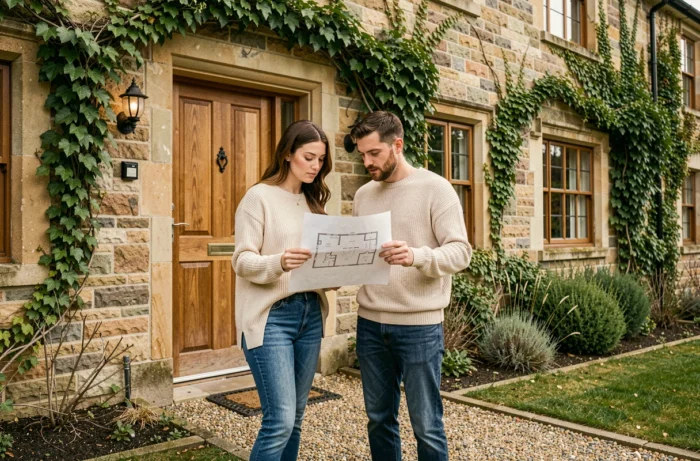
The French housing stock consists mainly of detached houses, and most buyers focus on floor area or the number of bedrooms when making a purchase. The problem is that these criteria lock a home into a particular layout.
A family welcoming a child, someone switching to working from home three days a week, or an ageing parent moving into a ground-floor room: each of these scenarios fundamentally changes how a house is used. Choosing a home that suits your needs therefore means looking beyond the original floor plan and considering how adaptable the property is from the moment you start your search.
An adaptable home: planning for remote work, family life and reduced mobility
Most home-buying guides list fixed criteria: number of rooms, proximity to shops, aspect. These factors matter, but they say nothing about a home’s ability to accommodate a change in lifestyle.
A separate office, for example, is not equally useful if it is a windowless alcove rather than a well-ventilated room with a reliable internet connection. For regular remote work, a separate room with natural light and a network socket can make a real difference to quality of life for years to come. If it can also double as a guest bedroom with a fold-away bed, the home becomes more versatile without adding floor space.
Household needs often change faster than expected. Before signing, it is worth checking a few practical details that determine how adaptable the property is:
- At least one ground-floor room that could be converted into a bedroom, with a water supply nearby, to accommodate someone with reduced mobility or an elderly parent.
- Whether the attic or an adjoining garage can be converted without altering the load-bearing structure, as this affects the true cost of a future extension.
- The width of passageways (hallways, doorways): a clearance of 80 cm or less makes it much harder to use a wheelchair or even a double stroller.
A property that meets these criteria does not necessarily cost more to buy. You can spot one by looking at the floor plan from a practical, rather than purely aesthetic, perspective. On the Maison Logo website, property listings let you view floor plans and identify this kind of layout before you even visit.
Location and quality of life: factors that matter in the long term
Location is the factor that is hardest to change after buying. You can remove a partition wall, renovate a kitchen or change the heating system. You cannot move the house.
The usual approach is to check the distance to schools, shops and public transport. That is a good starting point, but it overlooks less obvious factors. Fibre-optic availability, for example, directly affects whether remote work is practical. A rural home without a fibre connection may require fixed 4G or satellite internet, with speeds that can limit video calls or large file transfers.
The noise environment matters just as much as the view. A house overlooking a leafy garden may still be under a flight path or close to a railway line. Visiting the neighbourhood at different times and on different days is the only reliable way to gauge actual noise levels.
The local development plan: a document to check before your visit
The local development plan (PLU) sets out what can be built around the property. A nearby plot zoned for development could mean that an apartment block or housing estate changes the surroundings in the years after you buy. Checking the PLU at the town hall or online takes little time and can help you avoid costly surprises. A neighbouring plot zoned for development can radically change the surroundings of a house within just a few years.
Purchase budget and the real cost of owning a home over five years
The asking price of a house represents only a fraction of its true cost. Notary fees, property tax, mortgage insurance and routine maintenance (roof, exterior walls, boiler) all add up to a total that many buyers underestimate when signing.
Two costs deserve particular attention. The first is energy efficiency. The energy rating affects both thermal comfort and heating costs throughout the period you live in the property. A home rated F or G may require a substantial energy-efficiency renovation budget in the first few years, whereas a property rated B or C is more likely to need only routine maintenance.
The second often-overlooked cost is adaptation work. If the house needs to evolve (converting the attic, adding another bathroom, improving insulation), the cost of this work depends directly on the original design of the building. A traditional roof frame is better suited to conversion than an industrial trussed roof. The type of roof frame has a significant impact on the cost of a future attic conversion.
Build quality and what to look out for during viewings
Viewing a house is about more than getting a general impression. A few targeted checks can help you assess the actual build quality without being an expert.
- The condition of the exterior windows and doors: single-glazed windows or deteriorated seals point to poor insulation and the need to budget for replacements.
- Signs of damp (ceiling stains, mould at the bottom of walls, persistent odours): these often indicate a structural problem, not just poor ventilation.
- The electrical panel: an old panel with plug-in fuses suggests the installation is probably no longer up to code and will need to be brought into compliance.
- The condition of the roof as seen from outside: missing tiles, heavy moss growth or warped gutters are signs that repairs may be needed soon.
These observations are no substitute for a professional inspection, but they can help you rule out a problematic property before paying for expert assessments. Spotting warning signs during the first viewing saves time and money.
Bring in an independent professional before making an offer
An architect or building project manager will generally charge a few hundred euros for a technical second viewing. Their independent perspective can help assess whether planned work is feasible, estimate its cost and negotiate the purchase price with a clear understanding of the facts. For an older or unusual property, this expense often pays for itself during negotiations.
Choosing a home that suits your lifestyle means accepting that your lifestyle will change. The home that works for you today and ten years from now is not the one that ticks the most boxes on a standard checklist, but the one whose structure, location and budget allow you to adapt without starting from scratch.