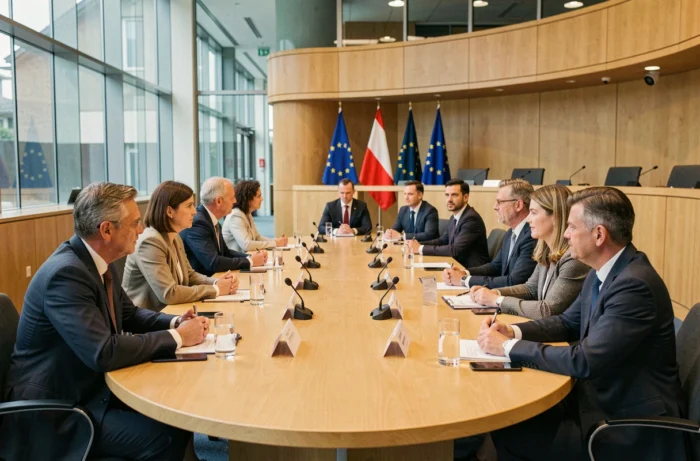
The European Council in October 2026 in Brussels crystallized several tensions between member states. Multiannual budget, military support for Ukraine, energy costs: the issues are piling up on the table of European leaders. Understanding these European news requires untangling technical negotiations that, behind institutional jargon, directly affect the daily lives of citizens.
EU Multiannual Budget: Why the Stalemate Persists
Have you ever noticed that European budget discussions always seem to drag on? The mechanism largely explains this. The multiannual budget, known as the multiannual financial framework, sets the spending ceilings of the Union for seven years. Each state must give its approval: this is the rule of unanimity in the Council.
For the period 2028-2034, the European Parliament rejected the Council’s draft position, deeming it too timid. MEPs are calling for a more ambitious budget, particularly to finance the energy transition and common defense. On the other side, net contributor countries, those that pay more than they receive, are slowing down any significant increase.
This standoff opposes two logics. Northern and northwestern states want to limit their contributions. Central and southern European countries, often net beneficiaries, advocate for maintaining cohesion funds that finance their infrastructure. The adoption of the budget requires unanimity in the Council and the consent of the Parliament, which makes any compromise slow and fragile.
To follow the evolution of these negotiations and other European issues, a useful resource is: https://www.eurowebinfo.org/, which aggregates analyses on the politics and economy of the continent.

Energy and Competitiveness: The Divides Among European States
The rise in energy costs does not affect all European countries in the same way. And the response to it divides governments. Why this disagreement?
The price of electricity depends on the national energy mix. A country that produces a lot of hydroelectricity or nuclear energy is less affected by gas price fluctuations than a country reliant on thermal power plants. When the EU sets a common pricing mechanism, such as the carbon market (the ETS system), some see it as a transition lever, while others view it as a hindrance to their industry.
Finland, Sweden, and Denmark defend the carbon market, believing it supports investments in clean industries and energy security. Germany and France, whose industrial fabrics are more exposed, are seeking compensation mechanisms for their companies.
This debate has concrete consequences. A company that manufactures steel or cement in Europe pays a carbon cost that its Chinese or American competitor does not pay. The carbon border adjustment mechanism (CBAM) is supposed to correct this imbalance, but its implementation remains gradual and contested by some trading partners.
Exports to China and Trade Tensions
The October summit also addressed the issue of exports to China. European leaders are trying to define a common position towards Beijing, balancing the protection of domestic markets with maintaining vital trade relations for certain sectors, notably the German automotive industry and French luxury.
Support for Ukraine: The Budgeting Debate in Brussels
Ukrainian President Volodymyr Zelensky has requested an additional €70 billion from the European Union for 2027. This amount, announced during the European Council, has provoked mixed reactions among the Twenty-Seven.
European leaders reaffirmed their support for Ukraine, but the question of funding remains open. Where would this money come from? From the common budget, already under strain? From pooled borrowing, as during the pandemic? From additional national contributions?
Each option poses a different political problem:
- A withdrawal from the common budget would reduce the funds available for the common agricultural policy or research programs, which several states refuse.
- A new pooled borrowing, modeled on the post-Covid recovery plan, faces opposition from the so-called “frugal” countries that do not want to create a permanent precedent.
- Additional national contributions depend on the political will of each government, often constrained by domestic electoral deadlines.
The resumption of Ukrainian strikes against Russian refineries, confirmed in mid-October, has also drawn criticism from Washington. This transatlantic divergence complicates coordination among Western supporters of Ukraine.
Artificial Intelligence and Human Trafficking: Two Less Publicized European Issues
The headlines focus on Ukraine and the budget. However, two other issues are progressing within European institutions.
Adoption of AI by Businesses in Europe
An analysis published by the EU on October 14, 2026, shows that the adoption of artificial intelligence is progressing in most strategic European sectors, but very unevenly. Media, energy, and electronics are integrating these tools more quickly. Mobility, tourism, and agri-food remain lagging behind.
The gap in AI adoption varies significantly by sector. This observation raises questions about future competitiveness: sectors that are lagging risk losing ground to their American or Asian competitors, who are investing heavily.
Combating Human Trafficking
The EU plans to strengthen its action against human trafficking, with a technological and economic component. This issue, less visible than budget negotiations, directly concerns migration policy and judicial cooperation between member states. Digital detection tools and monitoring of financial flows related to trafficking are among the proposed avenues.
European Policy: What the Coming Months Will Change
The EU’s institutional calendar is entering a dense phase. The multiannual budget ideally needs to be finalized before the upcoming major elections in several member states. Pierre Moscovici reminded that it is complicated to adopt a European budget before these deadlines, as campaigning governments avoid heavy financial commitments.
On the UK side, Prime Minister Andy Burnham has promised more powers to Scotland, a signal of internal recalibration post-Brexit. A return of the UK to the EU is considered premature by most observers, despite a softening of rhetoric in London.
In Albania, unprecedented protests against the government of Edi Rama add a Balkan dimension to European concerns, as the country is a candidate for membership.
The coming months will determine whether the Twenty-Seven can turn their statements of intent into concrete financial arbitrations, regarding both Ukraine and the budget. The gap between the ambitions expressed in Brussels and the national constraints of each state remains the main obstacle to collective European action.