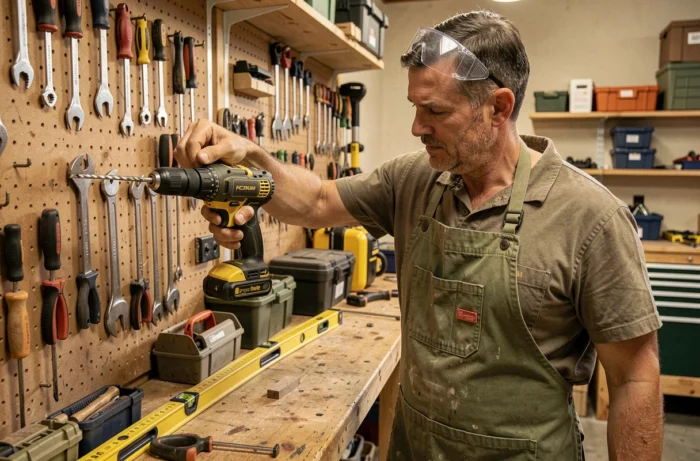
The consumer tools market has significantly expanded in recent years, with ranges that include dozens of references for each category. In the face of this abundance, assembling a coherent DIY toolkit for one’s home requires distinguishing between what constitutes a real technical foundation and what is merely a gadget or an impulsive purchase. The choice depends less on the skill level of the DIYer than on the nature of the planned work.
Common DIY tasks or renovation: equipment is not assembled in the same way
Hanging a frame on the wall and redoing the insulation of a room do not require the same tools or protections. For small household tasks (furniture assembly, shelf installation, touch-up painting), a well-stocked toolbox is sufficient.
As soon as a project involves structure, electricity, or plumbing, the constraints change. Personal protective equipment becomes a priority, and certain energy renovation work is eligible for programs like MaPrimeRénov’ or the zero-interest eco-loan, provided a certified professional is used. Knowing where DIY ends allows one to invest in the equipment offered by Blog du Bricoleur suited to their own projects, without accumulating unnecessary tools.
In practice, it is better to gradually acquire quality tools than to buy a complete low-cost set where half of the pieces will never be used.
Hand tools for DIY: the technical foundation not to be overlooked
Hand tools remain the basis of any intervention at home. Their reliability matters more than their quantity.
Measuring and marking before any cutting
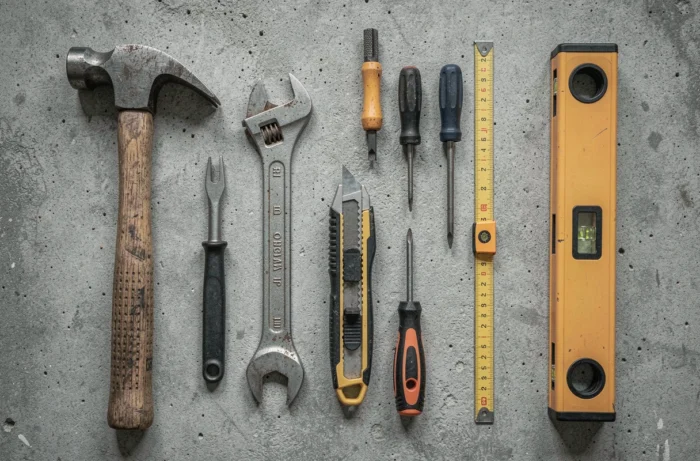
A good quality tape measure and a spirit level form the essential duo. Any measurement error will be costly during assembly, and an inaccurate level produces visible results to the naked eye on a shelf or frame. Opting for a tape measure with a locking mechanism and a magnetic tip makes solo work easier.
Striking, screwing, and tightening
A versatile carpenter’s hammer covers most domestic uses. For screwing, a set of screwdrivers (flat and Phillips, with at least three sizes of each) is more precise than a universal bit for stubborn screws. A slip-joint pliers and an adjustable wrench complete the set for tightening.
- Carpenter’s hammer with a fiberglass or ash wood handle, to absorb vibrations during repeated strikes.
- Screwdriver set with a through blade, allowing for striking at the end of the handle without damaging the tool.
- Slip-joint pliers with a ratchet, which adapts to various diameters for common plumbing fittings.
- Compact adjustable wrench for nuts and bolts found in furniture or household hardware.
Manual cutting
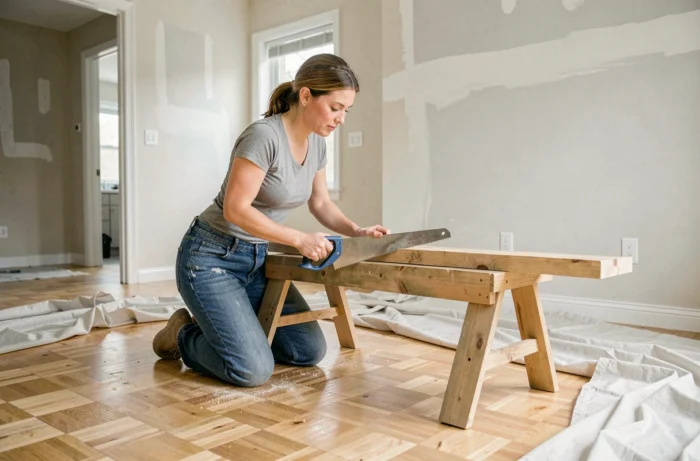
A universal tooth saw allows cutting medium-sized wood without resorting to power tools. For finer materials (profiles, PVC pipes), a metal saw with an interchangeable blade is sufficient. These hand tools have an advantage over electric saws for occasional cuts: starting precision, no adjustments, no noise.
Drill, jigsaw, and sander: when power tools are justified
Electric tools represent a more significant investment. The question is not to have as many devices as possible, but to cover the most frequently performed tasks.
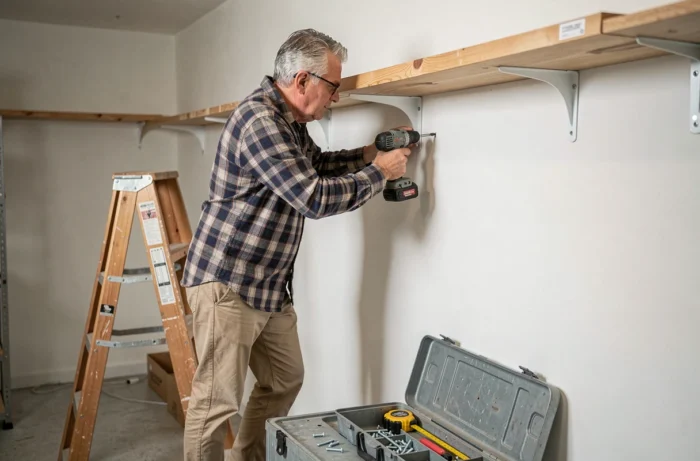
The cordless drill-driver is the most versatile electric tool for a home DIYer. It is used to drill wood, thin metal, certain construction materials, and to screw quickly. A model with variable speed and a self-tightening chuck covers the vast majority of situations. For drilling in concrete or solid brick, a dedicated hammer drill becomes necessary, as a standard drill does not have the appropriate percussion.
The jigsaw comes in second for curved cuts or adjustments of wooden panels. A vibrating or orbital sander is justified as soon as a project involves finishing wood or preparing a surface before painting.
Battery compatibility between tools of the same brand reduces overall costs and clutter. Checking this before purchasing avoids ending up with three different chargers in the workshop.
Safety on domestic sites: personal protective equipment and limits of DIY
Home accidents related to DIY are not anecdotal. The risks vary depending on the project: flying chips or dust during cuts, prolonged noise with electric tools, skin contact with solvents or wood treatment products.
Safety glasses, suitable gloves, and a dust mask are the minimum for any cutting or sanding operation. Hearing protection (molded earplugs or noise-canceling headphones) is justified as soon as the use of a circular saw, grinder, or hammer drill exceeds a few minutes.
- Wrap-around safety glasses, worn systematically during cutting and drilling.
- FFP2 mask for sanding wood, handling fiberglass, or chemical stripping.
- Reinforced handling gloves for handling sharp materials, and nitrile gloves for chemical products.
The available sources on occupational risks do not sufficiently document specific exposures to domestic DIY (treated wood dust, solvents in poorly ventilated environments). Properly ventilating the workspace remains the simplest and most often neglected precaution.
Assembling one’s toolbox involves a trade-off between the type of work actually planned and the quality of each piece. A limited but well-chosen set of tools covers almost all common DIY tasks at home. Electric tools are added over the course of projects, not in advance. Personal protective equipment is part of the toolkit just like the hammer or the drill.