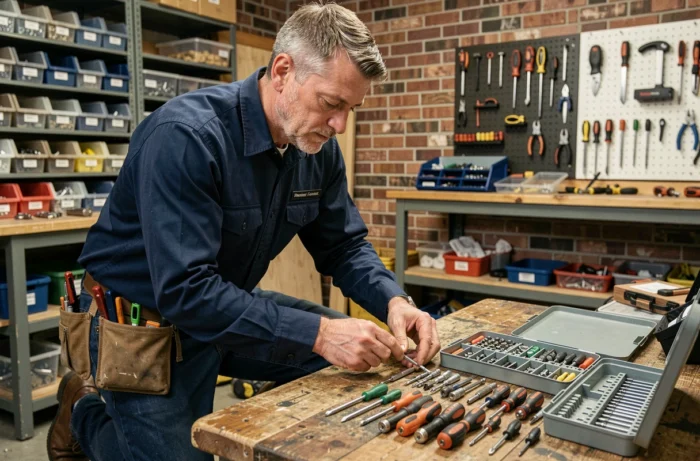
A Phillips PH2 bit used in a Pozidriv PZ2 recess applies torque at the wrong angle, rounds off the sides of the recess and makes the screw almost impossible to remove. This kind of mistake, common in workshops and during repairs, is not due to a lack of strength or tools, but to a geometric mismatch made easy by the visual similarity between recesses.
ISO 10664 standard and the limits of geometric compatibility
ISO 10664 defines the geometry of the internal hexalobular recess (Torx), but it does not specify the steel grade or heat treatment of the bit. A bit that conforms to the required shape can therefore fit the screw perfectly while deforming under load because its hardness or toughness is unsuitable for the application.
This mismatch between shape compatibility and mechanical strength is the leading cause of screw damage. We see the same problem with cross-head recesses: Phillips and Pozidriv bits share a cross-shaped profile, but the angle of the wings and the engagement depth differ. Confusing the two concentrates force on two points instead of four, causing the bit to slip out of the recess (cam-out).
Before choosing the different types of screwdriver bits for a project, you should therefore check two separate things: the shape of the recess and the bit’s strength rating relative to the expected torque.
Matching bit size to screw size: there is no universal rule
Standardized charts match a recess size to a nominal screw diameter, for example, a Torx T25 for a 5 mm screw. The head shape can affect this match. A countersunk screw and a pan-head screw of the same diameter do not always call for the same bit size, depending on the manufacturer’s specifications.
When repairing electronic or household appliances, manufacturers sometimes use unusual sizes. Forcing a bit that is slightly too small into the recess rounds off the screw’s internal corners, making it impossible to engage with the correct bit afterward.
Bits for impact drivers: a category of their own
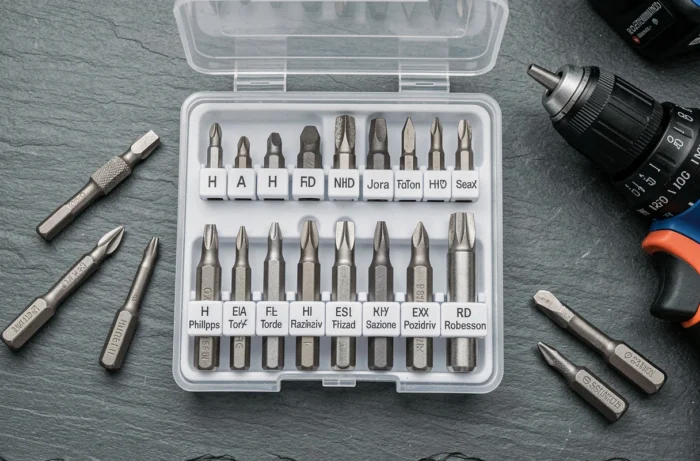
A standard high-hardness, hardened S2 steel bit handles the continuous torque of a conventional drill driver well, but it can snap under the repeated torque spikes of an impact driver. Bits marked “impact” have a torsion zone, often visible as a narrowed section of the shaft, which absorbs some of the kinetic energy before it reaches the tip.
The stated material alone is not enough to go by. Manufacturers’ safety recommendations advise checking for the explicit “impact” or “impact rated” label on the packaging, rather than judging suitability by the color (matte black) or coating.
- Standard bit (silver, hardened S2 steel): drill driver, bit holder screwdriver, moderate and steady torque.
- Impact bit (black or dark gray, torsion zone): impact driver, impact wrench, high torque delivered in short bursts.
- Extra-long impact bit (150 mm and longer): framing, wood decking, situations where screw depth requires extra clearance.
Using a standard bit with an impact driver risks shattering the tip. The resulting metal fragment can pose a real hazard, in addition to damaging the screw.
Torx and Pozidriv bits: tightening torque and cam-out resistance
The Torx recess (six-point star) provides a significantly larger contact area than a Phillips recess. Torque is distributed across six lobes instead of four wings, reducing stress at each contact point and greatly limiting the risk of cam-out.
With its offset double cross, Pozidriv falls between Phillips and Torx in terms of grip. It remains very common in European wood screws. Its distinctive feature is the four additional notches between the main wings, which keep the bit in position without requiring strong axial pressure, making one-handed driving easier.
Security recesses: Resistorx and Tri-Wing
Resistorx (or Tamper Torx) uses the Torx geometry with an added central pin in the recess. Without the matching hollow bit, the screw cannot be loosened. This recess is found on console housings, some medical devices and street furniture.
Tri-Wing (three wings arranged at 120°) is used mainly in consumer electronics. These security recesses make repairs more difficult if you do not have the right bit set, an issue directly linked to repairability.

Repairability and bit selection: what the ESPR regulation changes
The European Ecodesign for Sustainable Products Regulation (ESPR), which entered into force on July 18, 2024, sets the framework for future repairability requirements across many product categories. Detailed rules have not yet been established for every sector, but the direction is clear: manufacturers will gradually have to enable disassembly using commonly available tools.
In practice, this means proprietary or highly specialized recesses could give way to standardized ones (Torx, hex, Pozidriv). For a repair professional or DIY enthusiast committed to sustainability, investing in a set that covers these recesses is a sensible choice in the medium term.
- Choose a set containing at least Phillips PH1-PH3, Pozidriv PZ1-PZ3, Torx T10 to T40 and hex bits from 2 to 6 mm.
- Add a security bit set (Resistorx, Tri-Wing, Pentalobe) for repairing electronics and small household appliances.
- Check that long bits (at least 100 mm) are available in the most commonly used sizes, as some housings require deep access.
Maintain your bits to protect screws
A worn bit transfers torque unevenly. Its rounded tip slips in the recess, gouges the screw’s metal and turns a simple removal into a forced extraction. Replacing a bit costs a few cents; extracting a damaged screw can cost you the entire part.
A quick visual check of the tip after each session is all it takes. If the edges are visibly rounded or chipped, remove the bit from your set. For impact bits, also check the torsion zone: permanent deformation indicates that the bit has absorbed its share of energy.
Storage matters just as much as use. Bits left loose in a drawer knock against each other, become blunt and get mixed up. A magnetic bit holder or a case with individual slots prevents this gradual damage, which can ultimately affect the screws.