
During a school cafeteria strike at a primary school, the main concern for parents is not whether their child will be welcomed in class, but what happens between noon and 2 p.m. The statutory minimum childcare service covers school hours. Lunch breaks and after-school care are subject to separate decisions made by each municipality. Parents should therefore check three things separately: classroom attendance, school meals, and care after 4:30 p.m.
Minimum childcare service, school meals and after-school care: what each covers
It is common to confuse these three levels of care. The table below distinguishes between what is required by law and what depends on the municipality.
| Service | Responsible party | Guaranteed during a strike? | Meal included? |
|---|---|---|---|
| Minimum childcare service (school hours) | Municipality | Yes, required by law | No |
| School meals (cafeteria) | Municipality / provider | No, decided by each municipality on a case-by-case basis | Yes, when the service is operating |
| After-school care (morning/evening) | Municipality | No, varies by municipality | No (a snack may be provided) |
The minimum childcare service does not guarantee school meals. A child may be in class all day without being served lunch. Families should check their municipality’s announcements for each strike, as the decision to keep or suspend meal services varies from one municipality to another, and sometimes from one school to another.
Some families also discover that the school does not notify the meal service when a meal is cancelled. In Morteau, for example, the school meal service rules distinguish between a teachers’ strike (families are responsible for cancelling meals) and a municipal staff strike (meals are not charged). Parents who want to plan meals during a school cafeteria strike should therefore check directly with the meal service to find out whether they will be charged.
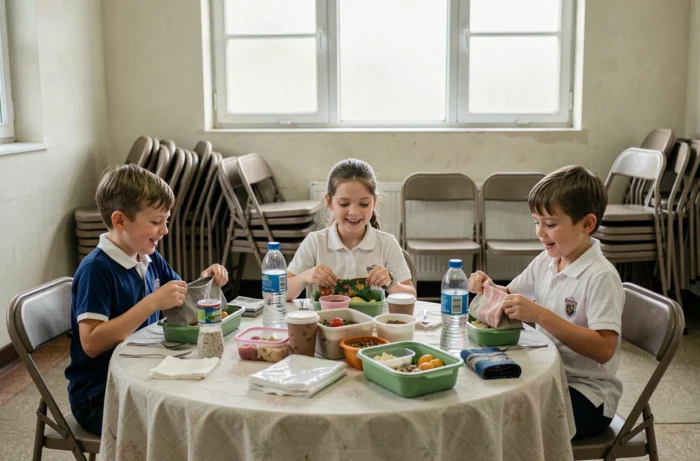
Cold lunches at school: food safety rules and parental responsibility
When the municipality keeps children at school during the lunch break but suspends meal services, it may allow families to provide a packed lunch. In Pessac, the city clarified that children would eat at school under the supervision of municipal staff, with a cold lunch brought from home.
This situation raises a question that is rarely anticipated: parents are entirely responsible for the contents of the meal and how it is stored. The school or municipality does not provide a dedicated refrigerator or a way to heat food. The meal must therefore remain safe at room temperature throughout the morning.
Cold lunches for a morning without refrigeration
A safe packed lunch follows a few simple but important principles.
- Choose foods that do not require an uninterrupted cold chain: bread, hard cheese, whole fruit, fruit purée pouches, dry biscuits, and washed, wrapped raw vegetables.
- Avoid fresh unpackaged dairy products, sliced deli meats exposed to heat, and any cooked dish containing mayonnaise or eggs.
- Use an insulated lunch bag with an ice pack to keep food at a safe temperature if the child will eat four hours after leaving home.
- Clearly label the contents if the child is eating in a shared room, to prevent children from swapping food.
Children with allergies or an Individualized Care Plan (PAI): special precautions
For a child with an Individualized Care Plan (PAI), the cafeteria normally follows a substitution or exclusion protocol. This protocol no longer applies when parents provide the meal.
Parents once again become solely responsible for ensuring the meal contains no allergens. Check the labels on packaged products, including for statements such as “may contain traces of.” If the child has a severe allergy (peanuts, tree nuts, or milk), it is best to avoid processed foods whose ingredients cannot be verified and prepare the entire meal at home.
The emergency kit (auto-injector pen, antihistamine) should accompany the child as usual. Inform the municipal staff supervising the children in writing that the child has an allergy, as the staff supervising the lunch break may not be familiar with the child’s PAI.

School meal charges on strike days: what the rules say
Whether families are charged depends on the cause of the strike and the school meal service rules. The arrangements differ depending on whether the strike involves teachers or municipal staff.
| Situation | Meal served? | Charge to parent |
|---|---|---|
| Teachers’ strike, cafeteria open | Yes | Yes, unless the parent cancels within the specified timeframe |
| Teachers’ strike, parent takes child home | No | Depends on the cancellation deadline in the local rules |
| Municipal staff strike, cafeteria closed | No | No (service not provided) |
| Mixed strike, childcare maintained without meal service | No (packed lunch) | No charge for the meal; supervision may still be charged, depending on the municipality |
Meal costs and supervision costs may be handled differently. Some municipalities charge for supervision during the lunch break even when no meal is served, because a municipal staff member is still providing a service. Others include both in a single fee. The school meal service rules, available from the town hall or on the municipality’s website, explain how charges are handled.
Preparing for a school cafeteria strike: what to check the day before
Most municipalities publish strike notices at least 48 hours in advance. Parents who follow official channels (the town hall website, school app, or notices posted at school) generally have a day to make arrangements.
- Check whether the cafeteria will be open or closed, independently of whether classes are running.
- Confirm whether packed lunches are allowed and under what conditions (designated room, supervision provided).
- Contact the meal service to cancel the meal if necessary, rather than waiting for the school to do it.
For families whose child has a PAI, preparing a cold lunch the night before helps avoid a rushed morning. Labelling the bag with the child’s name and the word “allergy” is also a useful precaution when supervision staff change.
A school cafeteria strike is usually a one-off event, but its practical consequences vary considerably from one municipality to another. The most commonly overlooked point is the distinction between school attendance and meal services: checking one does not mean you can skip checking the other.